
Best strategy for protecting wealth from lawsuits: 7 Powerful Ways (2025)
The Best Strategy for Protecting Your Wealth From Lawsuits
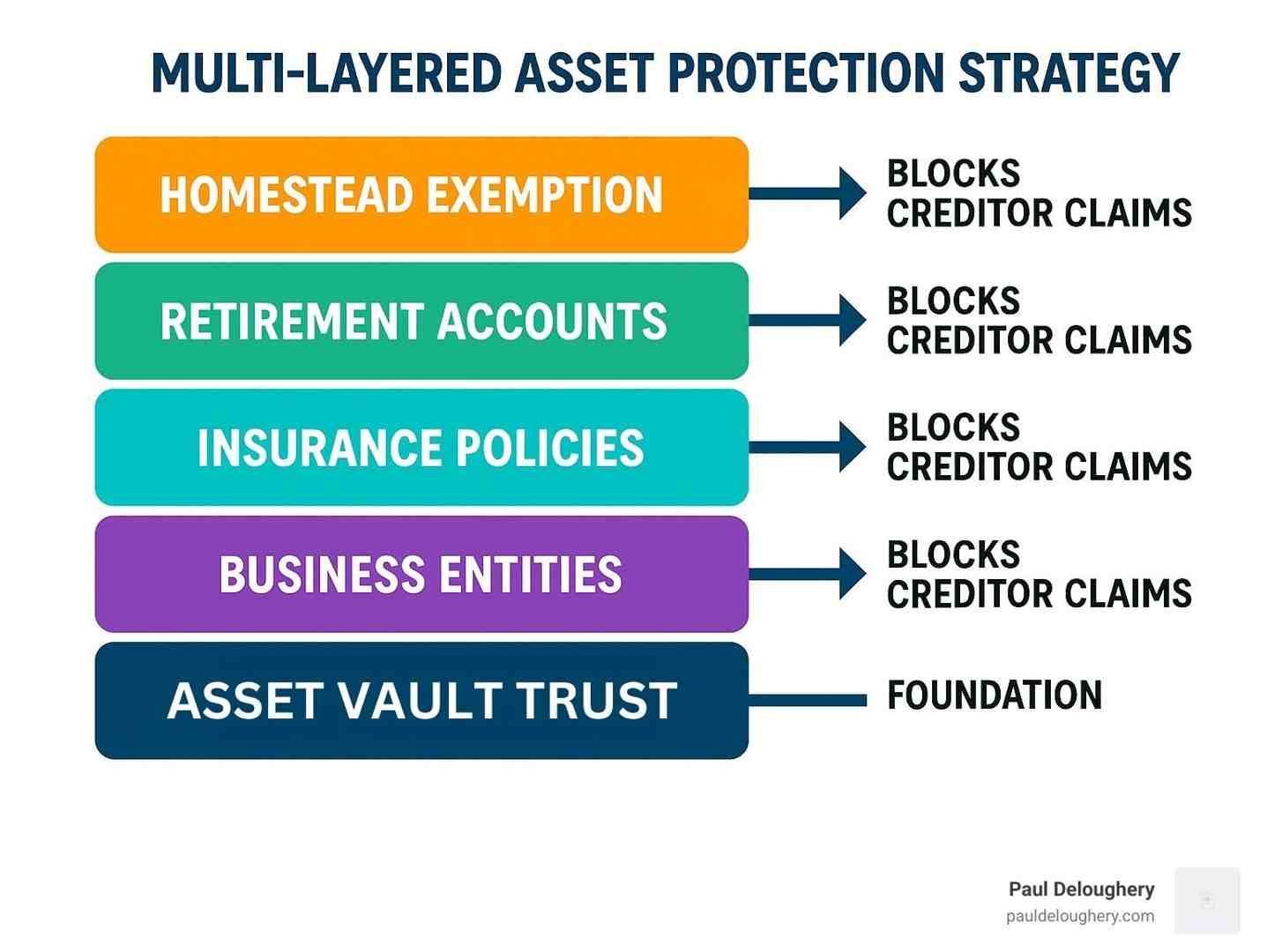
The best strategy for protecting wealth from lawsuits is a multi-layered approach combining:
- Asset Protection Planning – Provides strongest protection through layers of legal entities such as trusts, limited liability companies, and Family Limited Partnerships to separate personal and business assets
- Liability Insurance – First line of defense with umbrella policies extending coverage
- Statutory Exemptions – Maximizing retirement accounts, homestead protections, and life insurance
- Proper Timing – Implementing protection before any lawsuit threat materializes
In today’s litigious society, with over seven times more lawsuits filed annually than car accidents, safeguarding your hard-earned wealth has never been more critical. Whether you’re a business owner, professional, or high-net-worth individual, understanding how to legally shield your assets from potential creditors and lawsuit-hungry plaintiffs is essential to preserving your financial legacy.
Asset protection isn’t about hiding assets or evading legitimate obligations—it’s about creating legal barriers that discourage frivolous lawsuits and prevent catastrophic financial loss. The key is implementing these strategies proactively, well before any threat appears on the horizon.
I’m Paul Deloughery, an attorney with 25 years of experience helping clients develop comprehensive asset protection strategies that safeguard their wealth from lawsuits and ensure their legacies remain intact for generations. My expertise in the best strategy for protecting wealth from lawsuits comes from decades of seeing what works—and what doesn’t—when clients face real-world threats to their financial security.
Lawsuit Threat Landscape: Who’s Coming After Your Wealth?
The modern legal landscape can feel like a minefield for those who’ve built substantial wealth. Before we can talk about protection, we need to understand what we’re protecting against. Through my years helping clients in Minnesota and Arizona, I’ve seen how quickly wealth can become a target.
Think of your assets as a guide that attracts certain types of attention – not all of it welcome. The threats typically come in several forms:
Tort claims can arise when someone believes they’ve been harmed by your actions, even accidentally. That fender bender could turn into a six-figure nightmare if the other party claims lasting injuries.
Professional malpractice suits target doctors, attorneys, accountants, and other professionals. One unhappy client or patient can trigger a claim that threatens everything you’ve built.
Contract disputes start as simple business disagreements but can escalate into costly litigation that drags on for years, draining resources and energy.
Divorce proceedings remain one of the most common wealth destroyers. Without proper planning, a marital dissolution can cut your net worth in half overnight.
Creditor judgments might seem straightforward, but unpaid debts can result in court-ordered seizures that reach far beyond what you might expect.
What surprises many of my clients is the substantial gap in their insurance coverage. Your auto policy might cap at $300,000, but a serious accident could generate a $2 million judgment. Who pays the difference? You do – unless you’ve planned ahead.
Courts can also examine your financial moves retroactively. The “fraudulent conveyance” look-back period allows judges to unwind asset transfers made specifically to avoid creditors. In many states, this window extends 2-4 years, which is why timing becomes critical in the best strategy for protecting wealth from lawsuits.
The Most Common Plaintiffs You’ll Face
Not all potential litigants are created equal. Some are particularly motivated to pursue your assets:
Personal injury attorneys working on contingency have a direct financial incentive to target individuals with visible wealth. They receive a percentage of any settlement or judgment, so they’re naturally drawn to defendants who appear able to pay.
Disgruntled employees can pose a significant threat, particularly in today’s employment environment. Claims of wrongful termination, discrimination, or harassment can threaten both business and personal assets, often with minimal evidence required to initiate proceedings.
Former business partners know your operations from the inside. When business relationships sour, these individuals can become particularly dangerous adversaries, claiming breach of fiduciary duty or contract violations with insider knowledge to back their claims.
The harsh reality is that as your wealth grows, you become exponentially more likely to face litigation – deserved or not. Creating what I call a “poverty profile” through strategic asset structuring makes you a less attractive target while preserving your actual wealth.
Statistics tell the story: Americans are now seven times more likely to be sued than to experience a car accident. For high-net-worth individuals, the odds increase dramatically with each additional zero in your net worth.
The good news? With proper planning, you can significantly reduce your exposure to these threats without compromising your lifestyle or business operations. The key lies in implementing the right protections before you need them.
Choosing the Best Strategy for Protecting Wealth from Lawsuits

When my clients sit across from me asking about the best strategy for protecting wealth from lawsuits, I often use the fortress analogy. Think of your wealth as a castle that needs multiple layers of defense—moats, walls, and guards—each serving a unique protective purpose.
Asset Vault Trusts: The Best Strategy for Protecting Wealth from Lawsuits?
If you’re worried about losing your hard-earned wealth to lawsuits, divorces, or creditor claims, an Asset Vault Trust (AVT)—also called a 541 Trust or Special Power of Appointment Trust—may be your best legal fortress. And the best part? It’s 100% domestic. No need to stash your assets in some tropical jurisdiction where you lose all control.
An AVT provides maximum protection and maximum flexibility.
Unlike traditional revocable trusts (which are about as protective as a screen door in a hurricane), an Asset Vault Trust actually removes your legal ownership of the assets—while still giving you some indirect control through a carefully designed power of appointment. That means if someone sues you, those assets are legally not yours anymore. They’re out of reach. And yes, it’s completely legal when done right.
Here’s where it gets clever: AVTs use long-established principles of estate law to separate you from your wealth without disinheriting yourself. You can still benefit from the assets (via distributions to trusted family members or entities), but creditors can’t force a payout. Plus, since this trust is irrevocable, it signals to the legal world that you mean business.
Let’s be clear—this isn’t some shell game. Courts respect these trusts when they’re set up properly and not as a last-minute “oh no I’m getting sued” move. If you’re already knee-deep in litigation, it’s too late. But if you’re thinking ahead—say, you’re a physician, business owner, or someone with a target on your back—an Asset Vault Trust is your firewall.
No offshore accounts. No IRS Forms 3520 or 3520-A. No international trustees who disappear when you need them most. Just a robust, court-tested legal structure that keeps your assets safe, private, and close to home.
Bottom line? If you’re serious about protecting your wealth, the Asset Vault Trust is not just an option—it’s the move. But don’t DIY this. Get someone who’s been down this road before. At Sudden Wealth Protection Law, we’ve helped countless clients put these trusts in place before disaster strikes. Book a consultation now, before someone else decides to come after your money.
| Feature | Domestic Asset Protection Trust | Offshore Asset Protection Trust |
|---|---|---|
| Jurisdictions | 17 U.S. states | Valid in all states and under federal law. |
| Court Protection | Limited; U.S. courts have jurisdiction | Strong; they have been tested in every state and in federal court and have always withstood attack. |
| Setup Costs | $5,000-$15,000 | $5,000-$15,000 |
| Annual Maintenance | $1,500-$5,000 | None |
| Bankruptcy Protection | Limited; 10-year lookback | Specifically exempt under Section 541 of the bankruptcy code |
Layered Entities & Insurance: Another Best Strategy for Protecting Wealth from Lawsuits
While asset vault trusts offer robust protection, I always recommend building multiple defensive layers through properly structured business entities and comprehensive insurance coverage.
Limited Liability Companies (LLCs) form an excellent first line of defense by creating a legal separation between your business activities and personal wealth. Wyoming, Nevada, and Delaware offer particularly strong “charging order” protections, which limit what creditors can do even if they win a judgment against your LLC.
I typically advise clients to create separate LLCs for different asset classes—for example, having individual LLCs for each rental property rather than holding all properties in one entity. This compartmentalizes risk, preventing problems with one asset from threatening others.
One word of caution from my years of practice: maintaining proper corporate formalities is absolutely essential. I’ve seen too many cases where sloppy record-keeping or commingling personal and business funds led courts to “pierce the corporate veil,” effectively erasing the liability protection.
Family Limited Partnerships (FLPs) offer another powerful tool, especially for multi-generational wealth planning. As the general partner, you maintain control over the assets while distributing limited partnership interests to family members. If a creditor comes after a limited partner, they can only obtain a “charging order” against distributions—they can’t touch the underlying assets or force distributions.
Despite all these legal structures, insurance remains your frontline defense. A good umbrella policy providing $1-5 million beyond your standard coverage is relatively inexpensive peace of mind. For professionals, specialized liability insurance is absolutely essential. And if you serve on boards, directors and officers insurance provides critical protection against claims related to your decision-making role.
The limitation of insurance? It only covers what’s in the policy, up to specified limits, and typically excludes intentional acts and contract disputes. That’s why insurance alone is never enough.
Statutory Shields & Exempt Assets
Every state provides certain statutory protections that form another critical component of the best strategy for protecting wealth from lawsuits. These are essentially “freebies” the law gives you—protections you’d be foolish not to maximize.
Retirement accounts enjoy particularly strong protection. Employer-sponsored plans like 401(k)s and 403(b)s have unlimited protection under federal ERISA laws. IRAs currently have federal bankruptcy protection up to $1,512,350 (this amount adjusts for inflation every three years). Both Minnesota and Arizona, where I practice, provide additional state-level protections for retirement accounts.
Your home enjoys special protection through homestead exemptions, though the amount varies dramatically by state. Minnesota protects up to $450,000 of home equity ($1,125,000 for agricultural property), while Arizona shields $150,000. If you live in Florida or Texas, you’re in luck—these states offer unlimited homestead protection, making them popular destinations for asset protection planning.
Other protected assets include life insurance (with cash values often completely shielded from creditors—unlimited in Arizona) and annuities (which enjoy varying degrees of protection depending on your state). In some states, property held as tenancy by the entirety by married couples is protected from claims against just one spouse—a simple but effective protection for married couples.
By thoughtfully allocating your assets among these protected categories, you can significantly reduce your exposure to creditor claims while maintaining access to your wealth. The key is understanding exactly what’s protected in your state and structuring your holdings accordingly.
There’s no one-size-fits-all approach to asset protection. The best strategy for protecting wealth from lawsuits combines multiple layers of defense custom to your specific situation, assets, and goals. This multi-layered approach creates not just legal barriers, but practical ones that often discourage litigation before it even begins.
For more information about trust law and its role in asset protection, check out the Congressional Research Service’s report on trust law which provides valuable insights into how federal legislation impacts asset protection strategies.
Building a Multi-Layered Asset Armor Plan

When I sit down with clients to create their asset protection strategy, I often use the analogy of building a fortress. Just as a medieval castle had multiple defensive features—moats, walls, towers, and keeps—your financial fortress needs several layers of protection working together. This isn’t about one magical solution; it’s about creating a comprehensive system that makes your wealth increasingly difficult to reach.
The best strategy for protecting wealth from lawsuits always starts with understanding your unique situation. Every family’s risk profile is different. A surgeon faces different threats than a real estate investor, and your plan should reflect these realities.
Our proven 7-step process has helped countless families build robust protection:
- Risk Assessment: We begin by identifying what’s actually threatening your wealth—malpractice claims, business liabilities, or potential divorce complications.
- Asset Inventory: You can’t protect what you don’t acknowledge. We carefully catalog everything you own, from real estate to business interests to investment accounts.
- Exemption Maximization: Before creating complex structures, we ensure you’re taking full advantage of existing legal protections like retirement accounts and homestead exemptions.
- Entity Formation: For non-exempt assets, we establish appropriate LLCs, corporations, or family limited partnerships to create that crucial separation between business and personal assets.
- Trust Implementation: For your highest-risk assets, we may recommend trusts with carefully crafted spendthrift provisions.
- Insurance Review: Even with structural protections, comprehensive insurance remains your first line of defense—we make sure your coverage matches your actual risks.
- Maintenance Protocol: Asset protection isn’t a one-time event; it requires ongoing attention to maintain effectiveness as laws and your circumstances change.
Timing matters tremendously in asset protection. I’ve seen too many people rush to protect assets after receiving a demand letter or lawsuit notice—which is usually too late. The best protection happens long before clouds appear on your horizon.
Beyond these foundational steps, we often implement advanced techniques for clients with substantial assets at risk. Equity stripping can be remarkably effective—by placing legitimate liens or mortgages on property, you can make assets appear less valuable to potential creditors. For instance, a home with $500,000 in equity becomes much less attractive to creditors when it carries a $450,000 lien.
Private retirement plans offer another powerful tool in states that provide improved protection for these structures beyond traditional IRAs. These plans can shield significant assets while providing tax advantages.
For clients with substantial wealth, we might recommend split-jurisdiction trusts that leverage the protective laws of multiple locations. Imagine having trust administration in the Cook Islands, with assets held through a Swiss bank account—each jurisdiction adding another layer of complexity for potential creditors to steer.
The beauty of a multi-layered approach is that it creates what I call the “not worth it” factor. When a potential plaintiff and their attorney evaluate the cost and uncertainty of pursuing your protected assets against the likelihood of recovery, they often conclude it’s simply not worth the effort.
The goal isn’t to avoid legitimate obligations—it’s to discourage frivolous litigation and protect your family’s financial future from predatory claims. With proper Asset Protection Planning, you create a robust system that preserves what you’ve worked so hard to build.
Common Pitfalls and Compliance Essentials
Let’s face it – even the most carefully crafted asset protection plan can crumble if certain pitfalls aren’t avoided. I’ve seen too many clients learn this lesson the hard way, which is why I want to share the most dangerous traps that can undermine your best strategy for protecting wealth from lawsuits.
Fraudulent Transfer Risk is perhaps the most serious threat to your protection plan. Courts take a dim view of assets moved after a claim appears on the horizon. Judges can look back 2-4 years (sometimes even longer) to unwind transfers they deem suspicious. I once had a client who transferred property just weeks before being sued – the court reversed the entire transaction and awarded additional penalties.
The dreaded “Piercing the Corporate Veil” happens more often than you might think. Courts will strip away your LLC or corporation’s liability protection when they see:
Personal and business funds mixed together in the same account (I call this the “financial smoothie” mistake)
Corporate formalities ignored (missing annual meetings, unsigned minutes)
Entities running on financial fumes (undercapitalization)
Using your business as a personal piggy bank (the “alter ego” problem)
In one memorable case, a business owner’s protection collapsed because he used his LLC’s credit card to buy family groceries just once. That single transaction cost him millions in personal liability.
DIY Errors plague the self-implementers among us. Asset protection isn’t a weekend project – it’s a sophisticated legal strategy requiring professional guidance. The money saved on professional fees often pales in comparison to the protection lost through improper documentation or structural flaws.
State Law Variations create another layer of complexity. What works beautifully in Nevada might offer zero protection in California. For instance, only 17 states currently recognize domestic asset protection trusts – trying to use one in the wrong state is like bringing an umbrella to a hurricane.
To keep your asset armor strong and compliant:
- Partner with experienced legal and financial professionals who specialize in asset protection
- Maintain crystal-clear separation between personal and business finances (separate accounts, separate cards, separate everything)
- Document all transfers with proper, professionally-drafted legal agreements
- Calendar and complete all required disclosures and tax filings
- Schedule annual reviews to update your plan as laws evolve
I’ve helped countless clients steer these compliance challenges successfully. The peace of mind that comes from knowing your wealth is properly protected is worth every ounce of careful planning and maintenance. After all, the best strategy for protecting wealth from lawsuits isn’t just about creating barriers – it’s about maintaining them properly for years to come.
For more information about ensuring your wealth remains protected for generations, visit our guide to long-term wealth preservation.
Frequently Asked Questions about Asset Armor
What is the single best strategy for protecting wealth from lawsuits?
I hear this question all the time in my practice, and the truth is, there’s no one-size-fits-all answer. The best strategy for protecting wealth from lawsuits is always a personalized, multi-layered approach custom to your unique circumstances.
Think of it like building a custom home rather than buying something off-the-shelf. For many of my high-risk professional clients and those with substantial assets, combining an asset vault trust with domestic entities, comprehensive insurance, and statutory exemptions provides the strongest fortress around their wealth.
Your ideal protection plan depends on several key factors:
Your profession (a surgeon faces different risks than a real estate investor)
The types of assets in your portfolio (rental properties require different protection than investment accounts)
Where you live (state laws vary dramatically in what they protect)
Your family situation (married with children vs. single creates different planning opportunities)
Your budget for implementation and ongoing maintenance
During our consultations, we dig deep into these factors to craft a protection strategy as unique as your fingerprint.
How early should I start my asset protection planning?
The best time to plant a tree was 20 years ago. The second best time is today.
The same wisdom applies to asset protection planning. The ideal time to start is before you have any significant wealth to protect – which sounds counterintuitive until you understand why timing matters so much.
Courts can look back several years to unwind transfers made to avoid creditors (called “fraudulent conveyances”). The longer your protection structures have been in place, the more likely they’ll withstand scrutiny when you need them most.
I recommend starting your asset protection journey:
- When launching a new business venture
- As you enter a high-risk profession like medicine or law
- After receiving a substantial inheritance or windfall
- Before your wealth accumulation really takes off
- When you notice your net worth becoming an attractive target
Asset protection is preventative medicine for your financial health. By the time you’ve been served with lawsuit papers, many of your most powerful options have already disappeared.
Can I rely solely on insurance to shield my assets?
Insurance is essential – but it’s just one piece of the puzzle, not the entire picture.
I’ve seen too many clients find the hard way that their insurance coverage had unexpected gaps. While your liability policies should absolutely be your first line of defense, relying exclusively on insurance leaves you vulnerable in several critical ways:
First, policy limits can be woefully inadequate for catastrophic claims. A serious injury lawsuit can easily exceed even a generous umbrella policy.
Second, insurance policies are filled with exclusions and limitations in the fine print. I’ve seen clients shocked to find their “comprehensive” coverage didn’t apply to their specific situation.
Third, insurance typically doesn’t cover intentional acts, contract disputes, or certain business liabilities – leaving major exposure.
Finally, there’s always the risk your insurer could become insolvent or deny coverage when you need it most.
That’s why I always recommend a belt-and-suspenders approach: robust insurance coverage complemented by structural protections like trusts, LLCs, and statutory exemptions. This comprehensive strategy gives you multiple layers of defense against potential threats to your hard-earned wealth.
Asset Protection Planning requires looking at the complete picture of your wealth and creating integrated solutions that work together. When you’re ready to create your custom protection plan, I’m here to help guide you through the process.
Conclusion
Building effective asset armor isn’t about finding a single magic solution—it’s about creating a thoughtful, multi-layered system custom to your unique situation. The best strategy for protecting wealth from lawsuits combines several approaches working together to form a comprehensive shield around what you’ve worked so hard to build.
Think of your protection plan like a medieval castle—with moats, walls, towers, and guards all working together. Each element serves a purpose, and together they create a formidable defense that makes potential attackers think twice before launching an assault on your financial kingdom.
At Paul Deloughery, we’ve seen how proper planning creates peace of mind. Our clients sleep better knowing they’ve taken proactive steps to secure their wealth not just for themselves, but for generations to come. We specialize in helping families across Minnesota and Arizona create lasting legacies through thoughtful estate planning, strategic wealth preservation, and family governance that reflects your deepest values.
Asset protection isn’t about dodging legitimate responsibilities. It’s about discouraging opportunistic litigation and preserving your hard-earned wealth from those who might try to take it through frivolous claims. When done properly and ethically, it’s simply smart financial planning—like wearing a seatbelt while driving. You hope you’ll never need it, but you’ll be incredibly grateful it’s there if you do.
The most important takeaway? Don’t wait. The best time to implement protection strategies is long before storm clouds appear on your horizon. Once a lawsuit threat emerges, many protective options disappear or become legally questionable. Through our Legacy Secure Plan, we can help you build protection that stands the test of time and gives you confidence that your financial future remains secure.
Your legacy deserves protection. Your family deserves security. And you deserve the peace of mind that comes from knowing you’ve taken every reasonable step to safeguard what matters most. Whether through asset vault trusts, strategic entity formation, insurance planning, or maximizing statutory protections, a comprehensive approach provides the strongest defense against today’s litigious environment.
Ready to build your financial fortress? Contact us today to begin creating your personalized asset protection plan that secures your wealth for generations to come.