
Blended Family Inheritance: Secure Your 2025 Legacy
Why Blended Family Inheritance Demands Your Attention Now
Blended family inheritance presents unique challenges that traditional estate planning often fails to address. When you remarry with children from a previous relationship, the risk of unintentional disinheritance is high. This often happens when well-meaning people focus on avoiding probate without understanding the dire consequences for their children.
Quick Answer: Key Challenges in Blended Family Inheritance
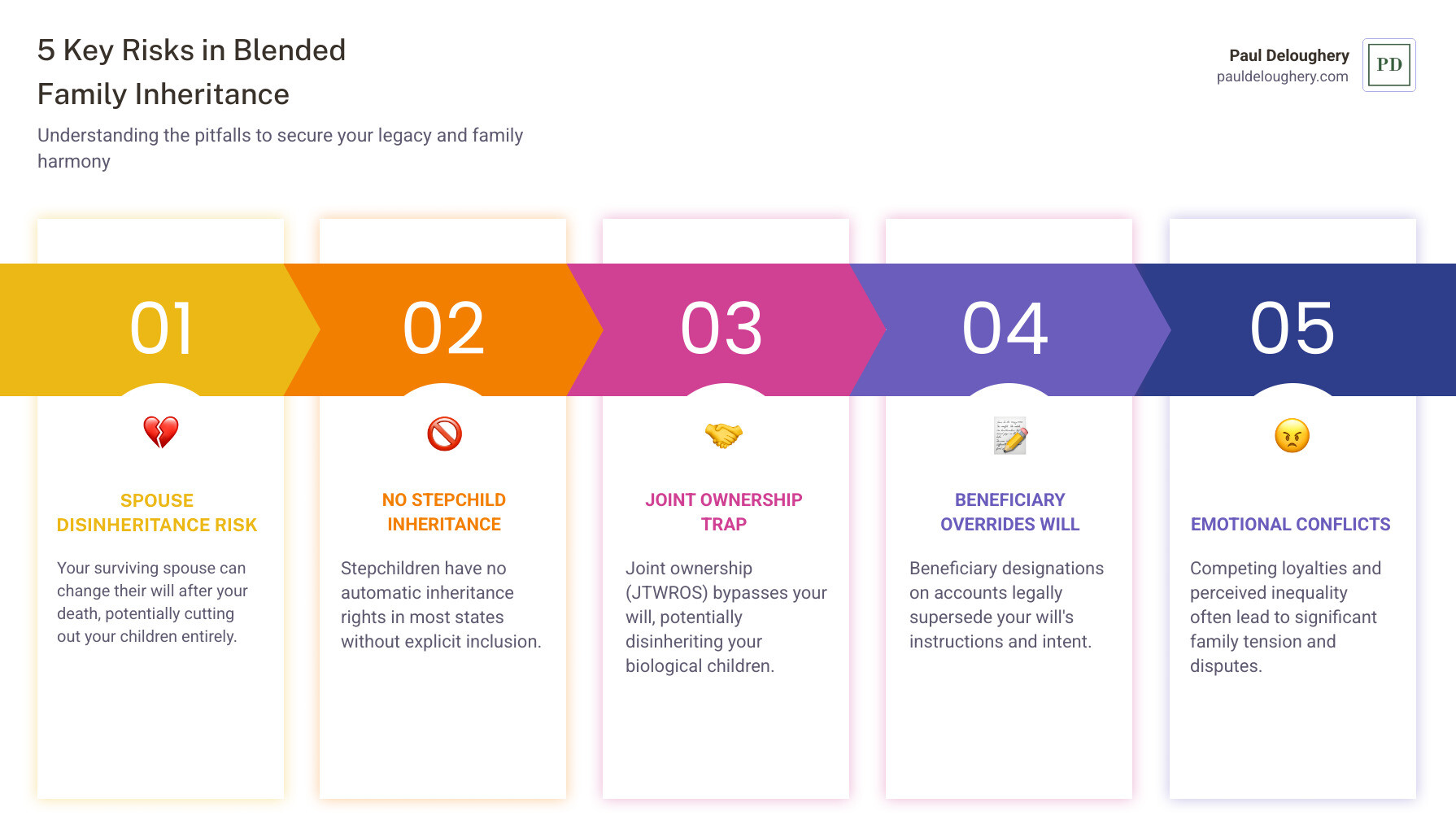
- Competing Loyalties – Balancing your spouse’s financial security with your children’s inheritance
- The Disinheritance Risk – Your surviving spouse can change their will after you die, cutting out your children entirely
- Legal Blind Spots – Stepchildren have no automatic inheritance rights in most states
- Common Mistakes – Joint ownership and beneficiary designations can override your will completely
- Emotional Conflicts – Perceived favoritism and old wounds from divorce create family tension
Statistics show that 40% of unions now include at least one spouse who has been married before. Yet most couples use simple “I leave everything to you” plans, which can lead to disinheritance. Many don’t realize that avoiding probate is not the same as protecting your family. Common probate-avoidance tactics like joint ownership or naming a spouse as the sole beneficiary can guarantee that children from a previous marriage receive nothing.
The problem is painful: when you die, your surviving spouse inherits everything. They can later rewrite their will, legally cutting out your children. This isn’t just about money; it’s about preserving family harmony. A poor plan breeds resentment and turns family members into adversaries. Blended families need a custom approach that balances competing interests and protects against future changes.
I’m Paul Deloughery, an estate planning attorney with 25 years of experience. I guide families through the complexities of blended family inheritance, integrating legal strategy with family values to protect everyone you love.
The Unique Challenges of Blended Family Inheritance
When you bring two families together, you create something beautiful but also complex. Blended family inheritance sits at the intersection of love, loyalty, and law. The core tension is clear: you want to ensure your current spouse is financially secure, but you also want to provide for your children from a previous marriage. These two goals can easily collide.
The simplest path—leaving everything to your surviving spouse—is also the most dangerous. This “surviving spouse takes all” pitfall is a leading cause of unintentional disinheritance. You may think you’re showing trust, but you’re actually handing complete control of your children’s inheritance to someone whose priorities may change over time.
The emotional landscape adds another layer of difficulty. Stepchildren may feel like outsiders, while biological children might worry about being replaced. These are real concerns that can create lasting family rifts if left unaddressed. With four in ten couples are saying “I do,” again, it’s clear that traditional estate plans are no longer sufficient. Understanding family conflict resolution is essential.
The Disinheritance Dilemma
Here’s how disinheritance often happens: You die first, and your spouse inherits all your assets. Years pass. They may remarry, grow closer to their own children, or simply drift apart from your kids. One day, your spouse updates their will, and your children are written out completely.
This is perfectly legal. Once assets are in your spouse’s name, they have the right to do as they please. Your intentions no longer matter. The influence from the surviving spouse’s biological children can be powerful, especially as your spouse ages. The painful truth is that assets can bypass your children entirely through legal channels that have nothing to do with fraud or theft. It’s the natural consequence of a plan based on hope instead of strategy. For more on these dynamics, see causes of family conflicts and how to resolve them.
Emotional and Relational Conflicts
Money and family are a volatile mix, especially in blended families.
- Managing expectations is critical, as everyone has different assumptions about who gets what.
- Perceived inequality feels like a judgment on love and belonging, not just a financial decision.
- Old wounds from divorce can resurface during inheritance discussions.
- Trust between stepparents and stepchildren is fragile and can be shattered by secretive or unfair plans.
This is why the need for open dialogue is paramount. Silence breeds suspicion and creates conflict. By avoiding uncomfortable conversations, you’re only postponing the fight until the worst possible moment—right after a death. These conflicts are preventable with the right approach to handling family conflict, honesty, and professional guidance.
Understanding the Legal Landscape: Default Rules That Can Derail Your Plan

If you don’t make an estate plan, the law makes one for you—and it rarely matches what you intended for your blended family. Understanding the default legal rules is essential, as they were built for traditional families and often contradict the wishes of modern ones. These rules cover intestate succession (dying without a will), spousal rights, and who legally qualifies as an heir.
The Dangers of DIY Probate Avoidance
Many people try to avoid the time and expense of probate, but in doing so, they often accidentally disinherit the very people they want to protect. They focus on the goal of avoiding probate without seeing the second and third-order consequences.
For example, adding your spouse to your house deed as Joint Tenants With Rights of Survivorship (JTWROS) means the house automatically passes to them, completely bypassing your will. Your children from a previous marriage get nothing from that asset, no matter what your will says. The same trap exists with beneficiary designations on retirement accounts and life insurance. These designations legally override your will. We’ve seen children lose hundreds of thousands of dollars because a parent forgot to update an old beneficiary form.
The problem isn’t avoiding probate; it’s using DIY strategies without understanding their full impact. Simplicity can come at the steep price of your children’s inheritance. For a deeper look, read about Avoiding Probate in Arizona and its hidden dangers.
Stepchildren’s Rights and the Law of Intestacy
Here is a hard truth: in most jurisdictions, stepchildren have no automatic inheritance rights unless they have been formally adopted. You may love them as your own, but the law does not see them as your “heir.”
If you die without a will (intestate), state laws distribute your assets to your spouse, biological children, and other blood relatives. Your stepchildren will receive nothing. This can be emotionally devastating for someone who has always been treated as family.
The only way to ensure your stepchildren inherit is to explicitly name them in a will or trust. Jurisdictional nuances matter—rules in Texas differ from those in Ontario, for example. This is why working with an experienced Attorney for Wills and Estate Planning is so critical. Don’t let default legal formulas decide your family’s future.
Strategic Tools for a Fair and Lasting Legacy
The complexity of blended family inheritance requires a customized strategy, not a cookie-cutter template. Proactive planning is the only way to ensure your legacy reflects your values and protects everyone. We integrate legal tools like wills, trusts, and marital agreements into a comprehensive plan. Our Estate Planning Legal Services are designed for this thoughtful approach.
Wills and Trusts: The Foundation of Your Plan
Every solid estate plan starts with a will. It’s where you specify who gets what, name guardians for minor children, and appoint an executor to carry out your wishes. But here’s the challenge: for blended families, a simple will often isn’t enough. In fact, it can create more problems than it solves.
| Feature | Will | Revocable Trust | Spousal Trust (e.g., QTIP) |
|---|---|---|---|
| Primary Purpose | Distributes assets, names guardians/executor | Manages assets during life & after death, avoids probate | Provides for surviving spouse, preserves principal for children |
| Probate Avoidance | No (assets pass through probate) | Yes (assets in trust avoid probate) | Yes (assets in trust avoid probate) |
| Control After Death | Executor follows instructions | Trustee follows instructions | Trustee follows instructions |
| Flexibility | Can be changed/revoked | Can be changed/revoked by grantor | Irrevocable after grantor’s death |
| Blended Family Benefit | Explicitly names biological & stepchildren | Protects assets for children, provides for spouse | Provides income for spouse, ensures principal for children from prior marriage |
| Common Pitfall | Can be overridden by beneficiary designations | Requires proper funding (transferring assets) | Can lead to conflicts if trustee isn’t neutral or if surviving spouse dislikes terms |
A spousal trust—particularly a Qualified Terminable Interest Property (QTIP) trust—is one of the most powerful tools we have for blended families. It provides your surviving spouse with income for life while ensuring the principal assets ultimately pass to your children. This prevents the disinheritance dilemma. Family trusts offer even more flexibility, but choosing a neutral trustee is key to preventing favoritism. A trust only works if it’s properly funded by transferring assets into it. An empty trust is useless. Learn more by reading The Living Trust Myth.
The Critical Role of Beneficiary Designations

This is where many plans fail. Beneficiary designations on retirement accounts like 401(k)s and IRAs, life insurance policies, and payable-on-death accounts legally override your will. Every single time.
If your will leaves your IRA to your children, but the beneficiary form names your spouse, your spouse gets the money. Period. Once they inherit it, they have complete control. The most dangerous mistake is naming your spouse as the sole beneficiary on all accounts, assuming they’ll “do the right thing.” That assumption has no legal weight.
Your beneficiary designations must align with your overall blended family inheritance strategy. Regular reviews are essential to prevent an outdated form from creating a family crisis.
Using Life Insurance and Marital Agreements Strategically
Life insurance is a versatile tool. It can create an “equalization fund” for children from a previous marriage, providing them a direct inheritance while other assets (like the family home) go to your spouse. It also provides liquidity to pay taxes and debts without forcing a fire sale of assets.
Marital agreements (prenuptial and postnuptial) are powerful estate planning tools. They clarify which property is separate versus marital and can waive spousal inheritance rights that might otherwise override your will. These agreements set clear expectations, preventing disputes before they start. The conversation may be awkward now, but it’s far less painful than future litigation. For more insights, explore Strategic Wealth Transfer.
Beyond the Documents: Building a True Multi-Generational Legacy

The best legal documents are only half the solution for blended family inheritance. Successful generational wealth transfer requires preparing the wealth for the heirs and preparing the heirs to receive the wealth.
This is where planning becomes personal. It’s about instilling family values, sharing your history, and helping your children and stepchildren understand the purpose behind the money. When heirs understand the work and sacrifice that built your wealth, they are more likely to steward it wisely.
Financial literacy is also key. We encourage families to have honest conversations about money management and the responsibilities of inheritance, custom to each child’s age and maturity. The goal is to build confidence, not anxiety. Our Family Governance, Legacy & Leadership resources can guide this process.
Equal vs. Equitable: What’s Fair in a blended family inheritance?
Here’s a question that keeps many blended family parents awake at night: should I divide everything equally, or is there a better way? In our experience, equal doesn’t always mean fair in the context of blended family inheritance.
One child may have received significant financial help for education, while another did not. Should their inheritances be the same? The answer depends on your definition of fairness. Some parents “equalize” inheritances to account for lifetime gifts; others do not. What matters is that your decision is intentional and clearly communicated. You can explain your reasoning in conversations or in a letter of instruction with your estate plan. For guidance on these conversations, explore How to Resolve Family Conflict Over Money.
The Power of Communication and a Living Estate Plan
Open communication is the most powerful conflict-prevention tool. Holding family meetings to discuss the “why” behind your plan can feel uncomfortable, but it manages expectations and prevents suspicion later. A neutral third party can help facilitate these discussions if needed.
Your estate plan should not be a “set it and forget it” document. Life events like marriage, birth, divorce, or death are all triggers for a review. We recommend a thorough review every three to five years, as laws and family dynamics change. Think of your plan as a living document that adapts with your family. Staying organized is crucial; see our guide on How to Organize Your Important Documents and Digital Information.
Frequently Asked Questions about Blended Family Inheritance
We hear these questions all the time from families navigating the complex world of blended family inheritance. They’re important questions, and they deserve clear, honest answers.
Do stepchildren automatically inherit if I die without a will?
The short answer is no. In most jurisdictions, including Ontario and Texas, stepchildren are not considered legal heirs under intestate succession laws. If you die without a will, the law distributes your assets based on blood relationships and legal adoption. Your stepchildren will be left out.
Explicit inclusion in a will or trust is absolutely essential if you want your stepchildren to inherit. The law will not assume your intentions.
Can my new spouse change their will and disinherit my children after I die?
Yes, and this is one of the most painful scenarios we see in blended family inheritance situations. If you leave everything directly to your spouse, they gain complete legal control of those assets. They can change their will at any time and for any reason, cutting out your children from a previous relationship.
This is precisely why we emphasize strategic planning tools like trusts in blended family situations. A spousal trust can provide for your spouse during their lifetime while legally ensuring the remaining assets pass to your children, protecting your original intentions.
What are the biggest challenges with blended family inheritance?
The challenges are interconnected and fall into three main categories:
- Financial Balancing: You must provide for your current spouse’s security while also protecting the inheritance of children from a previous relationship.
- Emotional Dynamics: Complex feelings about favoritism, exclusion, and old wounds from divorce are amplified by money, often leading to conflict if not managed with care.
- Legal Pitfalls: Default laws and common mistakes—like using joint ownership or outdated beneficiary designations—can easily derail your plan and lead to the unintentional disinheritance of your children.
The good news? All of these challenges are manageable with professional guidance, open communication, and a customized estate plan.
Conclusion: Secure Your Legacy and Family Harmony
The path through blended family inheritance is rarely straightforward, but with the right guidance and planning, it doesn’t have to be overwhelming. We’ve seen how default legal rules and simple planning mistakes can lead to unintentional disinheritance and family conflict. Relying on a handshake promise that a surviving spouse will “do the right thing” is a recipe for disaster.
But here’s the good news: you have the power to prevent these outcomes. With the right combination of trusts, beneficiary designations, and other strategic tools, you can create a plan that truly protects everyone you love. More importantly, you can build a legacy that preserves family harmony and prepares your heirs to be wise stewards of what you’ve built.
At Paul Deloughery, we specialize in creating customized plans that integrate legal strategy with your family’s unique dynamics and values. Your legacy deserves more than a one-size-fits-all solution. It deserves a plan that honors all your relationships and prevents future conflict.
Don’t let uncertainty or complexity keep you from taking action. The peace of mind you’ll gain—and the gift you’ll give your family—is immeasurable. Take the first step today to protect your family from future conflict and litigation. Your family’s harmony and your legacy are worth it.