
Business Succession Planning: Top 5 Mistakes
Why Business Succession Planning is Critical for Every Business Owner
Business succession planning is the process of preparing for an ownership transfer when you retire, become disabled, or pass away. Without a plan, even successful companies can face disruption, financial loss, or collapse during unexpected transitions.
Key Elements of Business Succession Planning:
- Exit Strategy – How and when you’ll leave the business
- Successor Selection – Who will take over leadership and ownership
- Business Valuation – What your company is worth today
- Funding Plan – How the transition will be financed
- Tax Strategy – Minimizing the tax burden on the transfer
- Legal Documentation – Contracts to protect all parties
Succession planning delivers value at any stage, whether retirement is 30 years away or not in your plans at all. The stakes are high. Unexpected events like disability, death, or partner disputes could cause the business you built to crumble. A good succession plan protects your life’s work, secures your family’s financial future, and ensures business continuity.
I’m Paul Deloughery, an estate planning attorney with 25 years of experience helping business owners steer the complexities of succession planning. I’ve seen how proper planning can preserve legacies for generations—and how a lack of it can destroy them overnight.
Business succession planning terms to remember:
What is Business Succession Planning?
Business succession planning is your roadmap for what happens when you’re no longer running the show. It’s a detailed instruction manual for your business’s future, ensuring it continues thriving without you at the helm.
A comprehensive plan covers your exit strategy, identifies and develops potential successors, establishes your business’s value, and puts the legal and financial pieces in place for a smooth transition.
Without a plan, your business faces serious continuity risk. When an owner suddenly departs, employees, customers, and partners are left in limbo, often leading to disputes and instability. The smart approach involves building a strong talent pipeline by identifying and nurturing internal leaders who can guide the company forward. You’re essentially future-proofing your life’s work.
Scientific research on succession trends shows that businesses with formal succession plans are more resilient and better positioned to maintain their competitive edge during leadership changes. All stakeholders—from employees and customers to family and investors—benefit from the security and confidence a clear plan provides.
Why every stage of business needs business succession planning
Thinking of succession planning as something for “later” is a costly mistake. Every stage of business benefits from it, just in different ways.
- Start-ups need basic buy-sell agreements to define what happens if a founder leaves, becomes disabled, or dies. This prevents chaos and protects everyone’s investment.
- Growth-phase businesses should identify high-potential employees and develop them into leaders. This creates a bench of talent ready to step into bigger roles as the company scales.
- Mature companies have the most complex needs, whether selling to a third party, passing the business to family, or transitioning to employees. Planning must address tax implications, valuation, and a smooth handoff that preserves relationships.
Key benefits at a glance
Proactive business succession planning offers transformative benefits for your business today.
- Risk mitigation acts as a safety net, preventing chaos during unexpected events by providing a clear path forward for employees, customers, and your family.
- A solid plan can boost your business valuation, as potential buyers and investors see a professionally managed company that isn’t entirely dependent on you.
- Talent retention improves when employees see clear paths for advancement, fostering loyalty and keeping valuable institutional knowledge within the company.
- For family businesses, planning preserves family harmony by establishing fair processes and transparent communication, preventing disputes that can tear families apart.
Step-by-Step Succession Roadmap
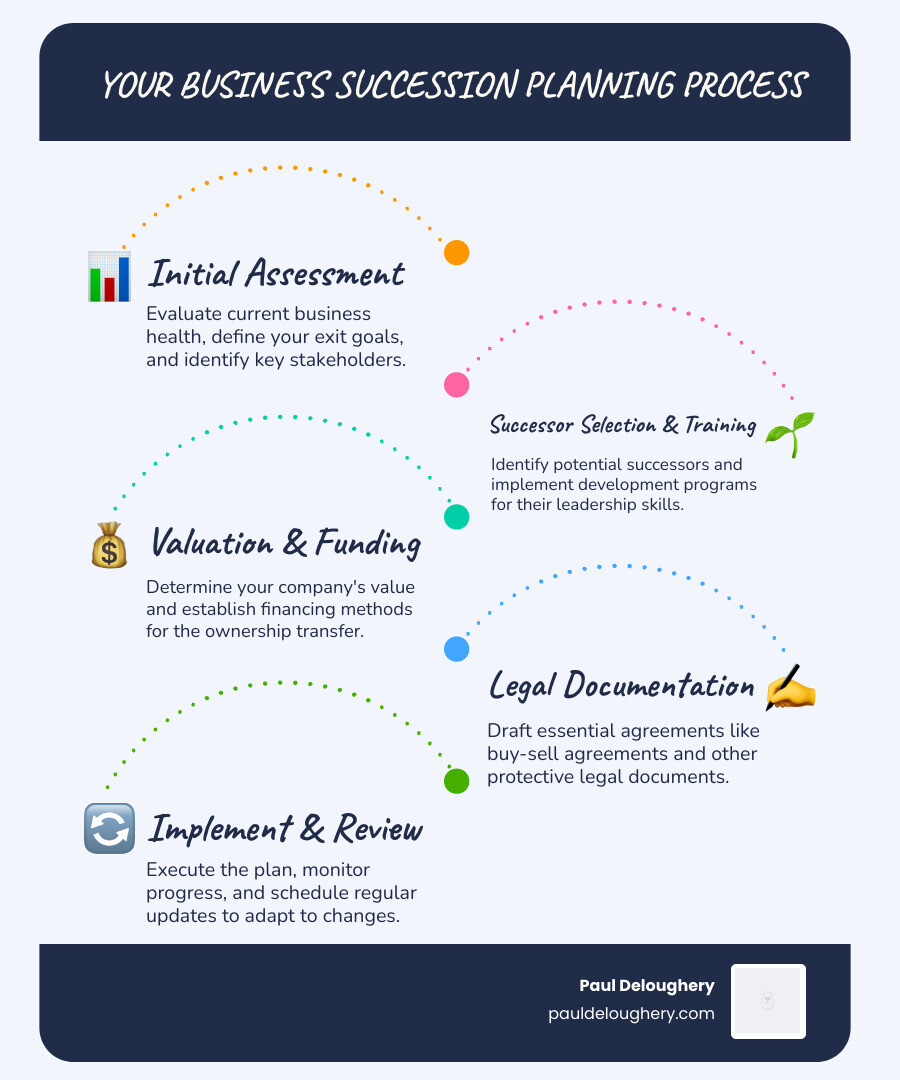
Creating a business succession planning roadmap is a manageable process when broken down into steps. It’s about knowing where you are, where you want to go, and how you’ll get there.
The journey begins with an assessment of your business’s health and your personal goals. This self-reflection is crucial, as the plan must align with your life goals.
Next is successor selection. This decision goes beyond skills; you’re looking for someone who shares your vision and can maintain the company culture.
Once a successor is identified, training and development begin. This is a gradual transfer of knowledge and relationships that can take years, ensuring the transition feels natural to all stakeholders.
Professional valuation is essential to understand your business’s worth. It informs your financial future, ensures fairness, and can reveal opportunities to increase value before the transition.
Exploring funding options is critical. Whether your successor buys you out, you use an Employee Stock Ownership Plan (ESOP), or life insurance plays a role, each choice has different tax and cash flow implications.
Finally, legal documentation, such as buy-sell and shareholder agreements, transforms your vision into a legally binding reality. This is where expert legal counsel is invaluable.
Two common paths are family transfers and employee buyouts. Family transfers focus on legacy, often involving gifting or discounted sales. Employee buyouts are typically fair market value transactions funded through ESOPs, seller financing, or loans.
| Feature | Family Transfer | Employee Buyout |
|---|---|---|
| Successor | Next generation of family | Key employees or management team |
| Motivation | Preserve family legacy, keep business in the family | Reward loyal employees, maintain company culture |
| Valuation | Often complex, may involve gifting or discounted sales | Typically fair market value for purchase |
| Funding | Gifting, loans from owner, trust structures | ESOPs, seller financing, bank loans, external investors |
| Emotionality | High, can involve family dynamics and personal issues | Generally lower, more business-focused |
| Control | May involve gradual transfer of control, mentorship | Can be immediate or phased, based on agreement |
Business Succession Planning Timeline
Successful business succession planning unfolds over years. Starting early provides the luxury of making thoughtful, unpressured decisions.
- 5-year milestones: Break your plan into actionable five-year goals. This might involve training successors or improving financials to boost company value.
- Emergency plan: You need a plan today for unexpected events. Who makes key decisions or accesses bank accounts if you’re suddenly incapacitated?
- Review cycles: Your plan is a living document. Annual reviews ensure it stays current with market conditions, personnel changes, and evolving laws.
Tools & advisors you’ll need
Effective business succession planning requires a team of experienced professionals.
- Attorney: Structures the transition legally and drafts essential documents like buy-sell agreements.
- CPA: Analyzes your financials and advises on the tax implications of different transition structures.
- Valuation expert: Provides an objective assessment of your business’s worth, removing guesswork from pricing.
- Insurance professional: Shows how policies can fund buyouts and ensure financial stability for your family.
Funding the transition
A brilliant plan fails without proper funding. How the transition is paid for affects everything from deal structure to tax consequences.
- ESOP: Employees gain ownership over time, often with significant tax benefits, fostering engagement and loyalty.
- SBA loans: Offer favorable financing terms for successors, making a purchase more accessible.
- Life insurance: Provides immediate liquidity to fund a buyout upon an owner’s death, preventing a forced sale of assets.
- Seller financing: You provide part of the financing, showing confidence in the business’s future while creating an income stream for yourself.
Understanding potential tax relief through scientific research on capital-gains exemption can significantly impact your strategy and should be explored with your CPA.
Tax, Legal & Valuation Essentials
The tax and legal aspects of business succession planning, when understood and managed with the right team, become powerful tools to save money and protect your family’s future.
When you transfer your business, you’ll face capital-gains taxes. However, planning ahead can minimize this burden. One key opportunity is QSBC-shares (Qualified Small Business Corporation shares), which may allow for significant capital gains exemptions if your business qualifies.
The legal backbone of your plan includes several key documents. Buy-sell agreements are crucial for businesses with partners, as they dictate what happens to an owner’s stake upon death, disability, or retirement. Trust-planning offers advanced strategies, especially for family businesses, allowing you to transfer ownership while maintaining some control and potentially reducing estate taxes. Your corporate-structure can also be optimized for a smoother, more tax-efficient transfer.
For comprehensive guidance on integrating these elements, explore our legacy planning services.
Minimizing taxes through early business succession planning
Starting your business succession planning early open ups tax-saving strategies that are unavailable at the last minute.
- Incorporation-timing: Your choice of corporate structure and when you establish it can significantly impact future tax liabilities.
- Lifetime-exemption: The exemption for qualified small business shares is one of the most valuable tax benefits available. Scientific research on capital-gains exemption shows how significant these savings can be, but meeting the criteria requires careful planning.
- Income-splitting: In family businesses, this can distribute income to family members in lower tax brackets, but strict rules apply. Professional guidance is essential to ensure compliance.
Legal documents that protect continuity
The strength of any business succession planning lies in its legal documents. They are your insurance against chaos and conflict.
- Shareholders-agreement: This is the rulebook for any business with multiple owners, outlining rights, responsibilities, and dispute resolution.
- Powers-of-attorney: These ensure someone you trust can make critical business decisions if you become incapacitated, preventing operational paralysis.
- Contingency-clauses: These clauses in your agreements provide a clear path forward if your original plan is disrupted by unforeseen events.
A word of caution on probate avoidance: While often a goal in business succession planning, I’ve seen families destroyed by poorly executed attempts. Adding a child to an asset to “avoid probate” can inadvertently disinherit other children or a spouse. In blended families, these mistakes are particularly devastating, leading to bitter disputes and litigation. It’s crucial to understand the full consequences of these strategies, not just the immediate goal.
Common Pitfalls & Best Practices
After 25 years in succession planning, I’ve seen the same preventable mistakes repeatedly. Knowing what to watch for is the first step to avoiding them.
The most common pitfalls include starting too late, which severely limits your options; having no written plan, which relies on assumptions that often crumble under pressure; and secrecy, which breeds uncertainty and resentment among employees and family.
Other frequent errors are successor conflict, which arises from choosing the wrong person or failing to prepare them adequately, and using stale valuations, which is like navigating with an outdated map.
Avoiding the top 5 business succession planning mistakes
Here are the five most costly mistakes and how to avoid them:
- Rushing the choice of successor: Take time to evaluate true leadership potential, not just current performance or family relationships.
- Ignoring tax implications: Involve a tax professional from day one to avoid losing a significant portion of your business value to preventable taxes.
- Underfunding the transition: A plan is useless without a realistic way to finance the ownership transfer. Explore all funding options early.
- Poor communication: Surprises are disastrous in business succession planning. Keep key stakeholders informed to build support and prevent resistance.
- Failing to review and update: Your plan must evolve with your business, family, and the law. Treat it as a living document.
Best-practice checklist
The most successful succession plans share several common elements:
- Start early: This gives you the luxury of time and choice.
- Integrate strategy: Make succession planning part of your annual business strategy, not a separate, one-time project.
- Train successors: This is a long-term investment in the future of your business. Give them time to learn the nuances of leadership.
- Conduct annual reviews: Schedule regular updates with your advisory team to keep your plan relevant and effective.
- Get outside advice: An objective, expert advisory team is essential for navigating complexity and avoiding costly errors.

Business succession planning is one of the most valuable investments you’ll ever make, protecting your life’s work, your family’s future, and the livelihoods of your employees.
Frequently Asked Questions about Business Succession Planning
In my practice, I’ve found that certain questions about business succession arise repeatedly. Here are answers to the most common concerns.
When should I start business succession planning?
The best time to start is right now, regardless of your age or how long you’ve been in business. The business owners who start early are the ones with the most options and the least stress.
Starting your business succession planning early gives you the invaluable gift of time. You have time to properly identify and train successors, structure tax-efficient deals, and strategically build your business’s value. Most importantly, you have time to pivot if circumstances change.
Even if you never plan to retire, unexpected life events like disability, illness, or family emergencies can change your timeline overnight. A plan protects the business you’ve built from being destroyed by the unexpected.
How often should my plan be updated?
Your business succession planning is a living document, not a one-time task. I recommend reviewing your plan at least once a year, or more frequently if your business or personal life undergoes significant changes.
Change is constant: your company grows, key employees come and go, market conditions shift, and tax laws evolve. An outdated plan can be useless. The successor you named may have moved on, or a chosen funding mechanism may no longer be viable.
Annual reviews are like a physical for your business’s future, allowing you to catch small issues before they become major problems and ensuring your plan remains aligned with your current reality and goals.
What if I don’t have a clear successor?
Not having an obvious successor is a common concern, but it doesn’t prevent you from creating an effective business succession planning strategy. It simply means we need to explore different paths.
First, look within your organization for employees with undeveloped leadership potential. With the right training, a hidden gem might emerge.
If no internal candidates are suitable, we can explore external options. This could mean preparing your business for an attractive sale to a third party by strengthening management systems and optimizing financials.
Another popular option is an Employee Stock Ownership Plan (ESOP), which allows your employees to collectively purchase the business over time. This can be a great way to reward a loyal team and preserve your company’s culture.
The key is to explore these options now. A flexible plan can be built to accommodate different scenarios, giving you peace of mind even if the final destination isn’t yet clear.
Conclusion
Business succession planning is more than a task on a to-do list; it’s about creating peace of mind for yourself and your family. You’ve poured years into building something remarkable. This planning ensures your vision, values, and hard work endure.
Proper succession planning future-proofs your legacy against life’s uncertainties. Whether you’re planning a peaceful retirement or preparing for the unexpected, a well-crafted plan delivers invaluable security.
At Paul Deloughery, we understand that your family’s legacy isn’t just about money; it’s about the family values you stand for. That’s why our approach to business succession planning goes beyond typical legal and financial strategies.
We believe successful generational wealth transfer requires preparing your heirs to receive and responsibly steward that wealth. This means instilling your family values, sharing your history, and helping the next generation understand the purpose behind the assets they will inherit. Without this crucial foundation, wealth can dissipate within a few generations, no matter how carefully the legal structures were crafted.
We are here to help you build a comprehensive framework that fosters family harmony and ensures your most important values endure alongside your financial assets. Let us help you steer these complex waters with the expertise you deserve.
For more information on how we can help you with your unique situation and goals, please visit our More info about legacy planning services.