
Estate and trust litigation 101: Avoid Disputes
Why Estate and Trust Litigation Matters for Your Family’s Legacy
Estate and trust litigation refers to legal disputes over wills, trusts, and the management of assets after a death. These conflicts can tear families apart and drain wealth that took generations to build.
Litigation often arises from grief and suspicion. Common triggers include unclear documents, claims of undue influence or mental incapacity, and trustee misconduct. These cases can take years and cost hundreds of thousands of dollars. But proactive planning can prevent most disputes.
Two of the most frequent and damaging claims are breach of fiduciary duty and undue influence. A breach occurs when a trustee mismanages assets or fails to put beneficiaries’ interests first. Undue influence involves manipulating a vulnerable person to change their estate plan. Both can destroy family relationships.
The stakes are enormous. Beyond the financial cost, litigation can permanently sever family bonds, destroying the very legacy parents worked to preserve. Children stop speaking, and grandchildren lose contact with their extended family.
I’m Paul Deloughery, an attorney with 25 years of experience in complex estate and trust matters. I’ve seen how litigation can devastate families, which is why I focus on proactive planning and dispute prevention to protect both wealth and relationships.
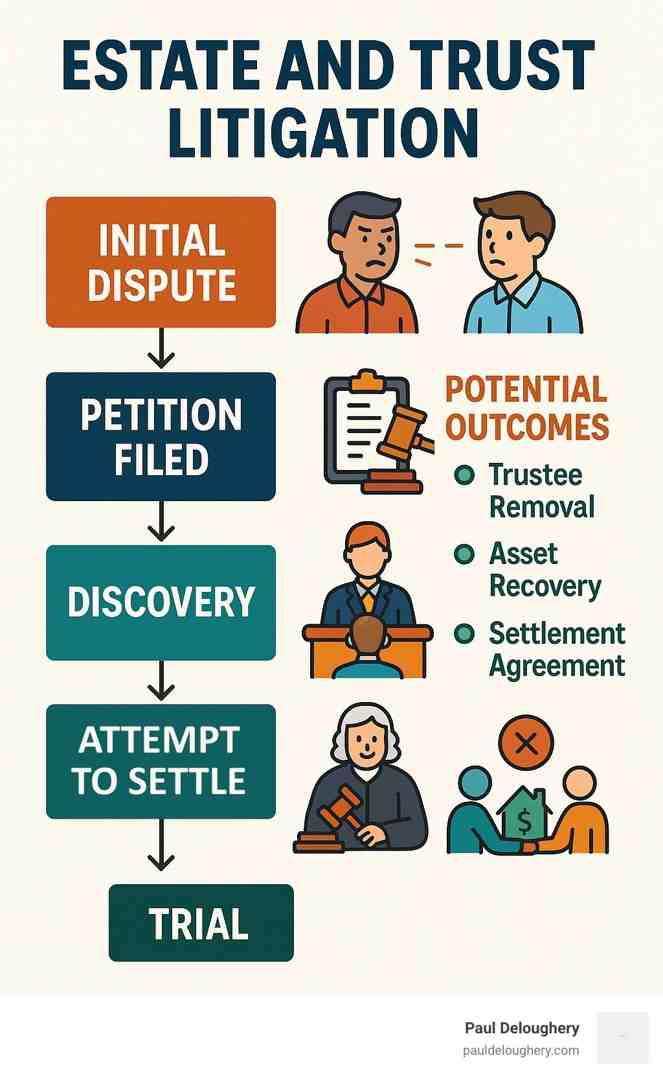
Estate and Trust Litigation: Key Legal Grounds
When families face estate and trust litigation, it’s often because something went wrong during a vulnerable time. Understanding the legal grounds for these disputes helps you recognize when your family’s legacy is at risk.
Undue influence is one of the most common claims. This occurs when a person in a position of trust manipulates a vulnerable individual to change their will or trust. To prove it, one must show the influencer had the opportunity and motive, the victim was susceptible, and the resulting estate plan is unnatural or suspicious.
Mental incapacity claims question whether the person understood what they were signing. The legal standard isn’t perfection; a person can have good and bad days. However, they must have been able to understand their assets, identify their natural heirs, and grasp the consequences of the document. Cases involving dementia or Alzheimer’s often rely on medical records and witness testimony.
Elder abuse can include financial exploitation, where someone steals from or manipulates a vulnerable elder. When an estate plan is changed as part of this abuse, families have grounds to challenge it in court.
Breach of fiduciary duty is the most common issue we handle. Trustees and executors have a legal duty to act with the highest level of trust. They must manage assets prudently, keep detailed records, communicate with beneficiaries, and always put the beneficiaries’ interests first. As scientific research on trustee duties confirms, proper management is critical. Self-dealing or making risky investments are clear breaches.
No-contest clauses are intended to deter challenges by stating that anyone who sues forfeits their inheritance. However, they are not absolute. Many states permit challenges based on probable cause and good faith, meaning you have a reasonable belief and evidence of wrongdoing.
Capacity tests are the standards courts use to determine if someone was mentally capable of making estate planning decisions when they signed the documents.
Our asset protection planning work often involves reviewing past transfers that could be challenged on these grounds.
Common Claims in Estate and Trust Litigation
- Will contests challenge the validity of a will due to improper signatures, lack of witnesses, or suspected fraud or undue influence.
- Trust contests raise similar issues for trust agreements, which are increasingly common for avoiding probate and maintaining privacy.
- Fiduciary breach claims target trustees, executors, or agents with power of attorney who have failed in their duties, such as by misusing funds or failing to communicate.
Statute of Limitations in Estate and Trust Litigation
Time is critical in estate and trust litigation. Each state’s probate code sets strict filing deadlines. For example, you may have as little as 120 days to challenge a trust after receiving notice. Missing a deadline usually means losing your right to sue, even with strong evidence. While tolling rules can sometimes extend these deadlines for issues like hidden fraud, relying on them is risky. If you suspect something is wrong, seek legal advice immediately.
The Litigation Process Step-by-Step
Facing estate and trust litigation can be overwhelming, but the process follows a predictable path. Understanding these steps can help you feel more prepared.
The process begins with petition filing, where your attorney formally outlines your concerns and asks the court for a remedy, such as removing a trustee or invalidating a will. Once filed, all involved parties are served and must respond.
Next is findy, or what lawyers sometimes call findy, because you’re finding out what happened. This is the legal detective work phase, involving document review and depositions (recorded interviews under oath) to gather evidence. It is often the longest part of the process.
Most courts now require mediation before a trial. A neutral mediator, typically an experienced attorney or retired judge, helps the parties communicate and explore solutions. Mediation often leads to a settlement, which allows families to resolve the dispute on their own terms, preserving privacy and often relationships.
If mediation fails, the case proceeds to trial. Here, a judge (and sometimes a jury) hears the evidence and makes a binding decision. If a party strongly disagrees with the outcome, they may file an appeal, which can add years to the process.
Throughout this process, understanding family dynamics is key. Our focus on More info about Handling Family Conflict helps families steer these challenges with minimal damage to their relationships.
| Feature | Settlement | Trial |
|---|---|---|
| Control | Parties control the outcome | Judge/jury controls the outcome |
| Cost | Generally lower | Significantly higher |
| Time | Generally faster | Can take years |
| Privacy | Confidential | Public record |
| Predictability | High, agreed upon by parties | Low, uncertain outcome |
| Relationships | Can preserve/repair relationships | Often damages relationships permanently |
| Stress | Lower | Very high |
Gathering Evidence
Building a strong case requires piecing together the right evidence. Financial records like bank statements, deeds, and tax returns are often the backbone, revealing the truth about how money was handled. Medical records are crucial for questions of mental capacity, and we may use experts to interpret them for the court. Witness testimony from family, friends, and caregivers provides the human element, painting a picture of what was really happening.
Mediation & Alternative Dispute Resolution
Most estate and trust litigation cases settle out of court through mediation. A neutral mediator facilitates communication, helping families find common ground. The benefits are significant: mediation is cost-saving, much faster than a trial, and confidential. Most importantly, it can preserve relationships by avoiding the public, adversarial nature of a courtroom battle. As scientific research on alternative dispute resolution confirms, it is highly effective. While not always successful, mediation offers families a chance to solve their own problems rather than having a decision imposed upon them.
Preventing Disputes Through Proactive Trust Administration
The best estate and trust litigation is the one that never happens. Prevention is worth far more than any courtroom victory.
Proactive trust administration is key. Transparent accounting, with clear, regular reports to beneficiaries, builds trust and prevents suspicion. When there are multiple trustees, co-trustee coordination is critical to avoid paralysis and conflict; their roles should be clearly defined. Regular updates and maintaining an accurate asset inventory are also essential practices that prevent misunderstandings from escalating into litigation.

Many families make costly mistakes trying to avoid probate. While More info about Transferring Assets to a Trust covers the mechanics, the obsession with probate avoidance can be dangerous. For example, adding one child to a bank account to bypass probate can unintentionally disinherit other children, as the account legally becomes the property of the named child. This focus on one problem often creates several others, setting the stage for future estate and trust litigation.
What most attorneys won’t tell you is that successful wealth transfer requires more than perfect legal documents. You must prepare your heirs to receive the wealth. I’ve seen families with bulletproof plans fall apart because the children didn’t understand the family’s values or the purpose behind their inheritance. When heirs understand the legacy, they become stewards, not just beneficiaries. Without this preparation, money becomes a source of division.
Drafting Bulletproof Documents
The foundation of a dispute-free estate is a rock-solid legal document. Precise language is crucial to eliminate ambiguity that fuels arguments. Professional drafting by an experienced attorney is vital, as online templates cannot account for unique family dynamics or state laws. For concerns about mental capacity, a formal capacity evaluation at the time of signing provides powerful evidence against future challenges.
Family Communication Strategies
Perfect documents are not enough without communication. Family meetings can prevent future problems by explaining the “why” behind your decisions and managing expectations. The goal is not to justify every choice but to prevent the shock and resentment that lead to litigation. Clear expectation-setting is especially important to avoid disputes over specific assets. These conflicts often stem from old rivalries, which is why we offer guidance on More info about Sibling Conflict Resolution to address issues before they escalate.
Remedies and Outcomes When Things Go Wrong
When disputes escalate to estate and trust litigation, courts have powerful tools to fix the problem and restore a loved one’s true wishes.
The most dramatic remedy is trustee removal. If a trustee has breached their duties through theft, mismanagement, or failure to communicate, a court can fire them. A successor trustee—a competent family member, professional, or trust company—is then appointed to manage the trust properly.
Financial consequences often follow. A surcharge forces a bad trustee to personally repay any money the trust lost due to their misconduct. Restitution requires them to return stolen assets. These remedies, often combined with an accounting order that forces full transparency, can recover significant wealth.
Many cases are resolved through a settlement agreement without a trial. These agreements can include financial payments, new distribution terms, or changes in trust operations, allowing families to move forward.

Court-Ordered Solutions
When parties cannot agree, a judge can impose solutions. A court may order a partition, which involves selling a property that cannot be easily divided and splitting the proceeds. In cases of fraud or breach of duty, a judge can create a constructive trust, declaring that property legally owned by one person actually belongs to another. These orders provide finality and allow families to move on.
Protecting Vulnerable Elders
One of the most tragic aspects of this field is financial elder abuse, where someone exploits an older person for personal gain. This can range from a caregiver convincing an elder to “loan” them money to a family member pressuring them to change a will.
If an elder can no longer manage their affairs, a court may establish a conservatorship, appointing a responsible person to manage their finances and protect them from exploitation. Many professionals, like doctors and lawyers, have mandatory reporting duties if they suspect abuse, creating a crucial safety net. Legal remedies can recover assets, but they cannot undo the emotional toll of this betrayal. For more information, resources like the scientific research on elder abuse can be invaluable.
Frequently Asked Questions about Estate & Trust Disputes
Families facing potential estate and trust litigation often have similar questions. Here are answers to the most common concerns.
What does “breach of fiduciary duty” mean?
A fiduciary is someone entrusted with managing assets for others, such as a trustee or executor. They have a legal duty to act with complete loyalty and care. A breach of fiduciary duty occurs when they violate this trust. The most important trustee duties are loyalty, prudence, impartiality, and communication. The most obvious breach is self-dealing—using trust assets for personal benefit, such as “borrowing” funds or selling trust property to a relative at a discount. When a breach occurs, beneficiaries have the right to hold the fiduciary accountable and recover any losses.
How long does an estate and trust litigation case take?
Predicting a specific timeline is difficult due to many variables. The complexity of the case is a major factor; a simple case with clear evidence might resolve in six months to a year, while a dispute involving undue influence could take several years. The willingness of the parties to cooperate also significantly impacts the timeline. Most cases are resolved within one to three years, but it’s wise to prepare for a longer process while hoping for a swift resolution through settlement.
Can a no-contest clause stop me from filing a claim?
A no-contest clause aims to disinherit anyone who challenges a will or trust. But here’s the kicker: these clauses aren’t always enforceable. Their power hinges on state law and the specific facts of your case.
In Arizona, for example, Arizona Revised Statutes (A.R.S.) § 14-2517 makes it clear: a no-contest clause is unenforceable if there’s “probable cause” for bringing the challenge. This means if you have a legitimate reason and solid evidence (like medical records showing incapacity) to believe something was amiss, you might be able to file a claim without forfeiting your inheritance.
Before you act, a professional risk assessment is vital. It helps you evaluate your evidence and understand the potential outcomes. Don’t let these clauses automatically deter you, but always seek experienced legal advice first.
Conclusion
Estate and trust litigation is rarely just about money; it’s about broken trust and damaged relationships. At its heart, navigating these issues is about preserving what matters most: your family’s legacy and harmony.
Legacy preservation means ensuring the values and purpose behind your wealth survive along with the assets. Courtroom battles often destroy the very legacy families are fighting to protect. This is why dispute avoidance through proactive planning is our highest priority.
Successful wealth transfer requires more than just legal documents; it requires preparing your heirs. When children and grandchildren understand the family’s history, values, and the purpose of their inheritance, they become good stewards. This requires open conversations about responsibility and expectations.
If you are currently facing a dispute, resolution is possible through mediation, settlement, or, if necessary, court action. For those looking ahead, the time to plan is now. Proactive planning and clear communication are the best ways to protect your family and your legacy for generations to come.
We are here to help you steer these challenges. Our approach integrates the legal, financial, and family dynamics that are essential for building an enduring legacy. For more information, please visit our page on More info about estate planning services.