
Family Protection Trust: Secure Your Legacy 2025
Why Understanding Family Protection Trusts Is Essential for Your Legacy
A family protection trust is a legal arrangement to safeguard your assets and provide for loved ones across generations. It involves three key parties:
- Settlor: The person who creates and funds the trust.
- Trustee: The individual or entity managing the trust assets.
- Beneficiary: The person(s) who receive benefits from the trust.
Its primary goals are asset protection from creditors, lawsuits, and care costs, alongside facilitating generational wealth transfer. However, as one expert noted, “Your family’s legacy is not just about money, it’s about family values.” Protecting wealth is vital, but preparing heirs to manage it responsibly is equally important.
Many families focus on avoiding probate or taxes without considering the broader consequences. Mistakes made while trying to protect assets can lead to unintentional disinheritance, especially in complex blended families. The key is understanding if a family protection trust is the right solution for your specific situation.
I’m Paul Deloughery, an estate planning attorney with 25 years of experience. I help families protect their wealth and prepare their heirs, using properly structured trusts to preserve financial assets and family harmony.

Quick family protection trust terms:
What is a Family Protection Trust and How Does It Work?
Imagine placing your valuable assets—your home, investments, and savings—into a secure vault. You give a trusted guardian detailed instructions on how to share those treasures with your family. That’s essentially what a family protection trust does.

As the “settlor,” you create the trust and transfer assets to a “trustee,” who legally manages them for your “beneficiaries.” The key is that once assets are in the trust, they are no longer legally yours. This separation, or “ring-fencing,” creates a protective barrier, shielding your wealth from creditors, divorce proceedings, or long-term care costs.
The trust agreement is your detailed instruction manual, outlining the trustee’s powers and distribution rules. Discretionary trusts are popular because they give the trustee flexibility to support beneficiaries based on their needs, which is useful for protecting those not ready to handle large sums.
You must also choose between a revocable and irrevocable trust. A revocable trust can be changed or canceled, but offers less asset protection. An irrevocable trust is difficult to change, meaning you give up direct control but gain significantly stronger protection.
For detailed guidance, see our resource on Transferring Assets to a Trust.
The Core Components of a Trust
Every family protection trust is built on fiduciary duty—the trustee’s legal obligation to put your beneficiaries’ interests first. They must manage the trust property with honesty, loyalty, and prudence.
The transfer of ownership is what makes the trust effective. The trust becomes the legal owner of the assets, which is the foundation of its protective power.
While the trust agreement is the legal framework, I recommend creating a Letter of Wishes. This non-binding document is a heartfelt letter to your trustee, explaining your hopes, values, and intentions. It provides crucial context that helps ensure your vision lives on, changing a legal arrangement into a reflection of your family’s unique story.
The Primary Benefits: Safeguarding Your Wealth and Heirs
A family protection trust builds a fortress around your assets, shielding them from various threats while allowing your family to benefit.
Asset protection is a primary benefit. By placing assets into an irrevocable trust, they are typically moved beyond the reach of future lawsuits, creditor claims, or personal bankruptcy. This is crucial for business owners or professionals in high-risk fields.
Divorce protection is also significant. An inheritance received outright by your child could be lost in a divorce. A trust keeps those assets within your bloodline, managed according to your wishes, not a court’s orders. This structure also prevents “sideways disinheritance,” where a surviving spouse remarries and your assets end up with their new family instead of your children.
Long-term care planning is another key benefit. Assets placed in an irrevocable trust well before care is needed may not be counted for Medicaid eligibility, potentially preserving your estate from being depleted by high care costs. For more on wealth protection, explore our guide on the Best Strategy to Protect Wealth.
Finally, a trust allows for controlled generational wealth transfer. You can dictate how and when beneficiaries receive their inheritance, which is vital for vulnerable family members or those with special needs. Distributions also happen privately, avoiding the public probate process.
Beyond the Balance Sheet: Preparing Heirs for Inheritance

Statistics show that 70% of wealthy families lose their wealth by the second generation, and 90% by the third. The cause is rarely poor investments; it’s unprepared heirs. A family protection trust can be a tool for family education, protecting your family from the internal challenges of sudden wealth.
- Family values and history are the foundation. When heirs understand the story behind the money, they are more likely to be responsible stewards.
- Financial education is crucial. Trusts can be structured with phased distributions tied to milestones, allowing heirs to develop money management skills gradually.
- The purpose of wealth matters. Aligning trust distributions with your family’s values—such as entrepreneurship or philanthropy—gives wealth meaning.
Open communication about wealth and responsibility is key to preventing conflict. This holistic approach, combining legal protection with family preparation, is what separates successful wealth transfers from the statistics. It’s about creating responsible stewards, not just lucky recipients.
Learn more at Family Governance & Legacy Leadership and Multi-Generational Wealth Planning.
Navigating the Complexities: Risks, Costs, and Tax Implications
While a family protection trust offers remarkable benefits, it’s not a simple solution. It’s crucial to understand the potential downsides before moving forward.

One significant hurdle is the loss of control with an irrevocable trust. Once you transfer assets, the trustee has the ultimate decision-making power. Trusts also require complex administration, including ongoing record-keeping, meetings, and financial reporting.
Costs are another reality. Setup for a comprehensive trust can range from a few thousand to over $15,000, depending on complexity. Annual administration fees for accounting and professional trustees continue for the life of the trust.
Potential disadvantages include:
- Upfront and ongoing costs
- Loss of direct control over assets
- Administrative complexity requiring careful attention
- Potential for trustee mismanagement
- Possible tax disadvantages in certain situations
- “Deliberate deprivation” challenges if created to avoid imminent care costs
- Mortgage complications when transferring financed property
The Living Trusts – Probate and Planning – Minnesota Attorney General handbook offers more insight into these administrative requirements.
Understanding the Tax Landscape
The tax implications of a family protection trust are intricate. For income tax, a trust is a separate taxpayer. If the trust retains income, it faces compressed tax brackets, meaning it can reach the highest federal tax rate with far less income than an individual.
For Capital Gains Tax, trusts generally have lower annual exemptions than individuals, potentially making sales of assets more costly. Regarding estate and gift tax, transferring assets into an irrevocable trust is often a taxable gift that uses part of your lifetime exemption. However, this can remove those assets from your taxable estate, potentially saving significant estate taxes later.
Trust taxation requires strategic planning to minimize the overall burden. The Trusts: definitions, types and taxation | UMN Extension resource provides a good overview, but personalized analysis from a tax professional is essential.
Family Protection Trusts vs. Other Estate Planning Tools
Effective estate planning isn’t about a single tool; it’s about a comprehensive strategy. A family protection trust is powerful, but it’s important to see how it compares to other common tools.
| Feature | Will | Family Protection Trust (Irrevocable) |
|---|---|---|
| Effectiveness | Only upon death | Immediately upon creation and funding |
| Probate | Assets pass through probate | Assets generally avoid probate |
| Asset Protection | No protection from creditors/lawsuits | Strong protection from creditors/lawsuits |
| Privacy | Becomes public record during probate | Private document |
| Control | You retain full control until death | Trustee controls assets (you may be a beneficiary) |
| Flexibility | Easily changed until death | Difficult to change once established |
| Cost | Generally lower setup, higher probate fees | Higher setup, lower/no probate fees |
A will is a foundational document, but it only works after death and requires assets to go through the public probate process. In contrast, a funded family protection trust works immediately, manages assets during your life and after, and typically avoids probate, saving time, money, and ensuring privacy.
Powers of attorney are also vital, but for a different purpose. They protect you during your lifetime by appointing someone to manage your financial or healthcare decisions if you become incapacitated. These tools work together as part of a complete plan. See how we integrate them in our Estate Planning Services.
The Pitfalls of DIY Probate Avoidance
Many people focus so on avoiding probate that they create bigger problems. Simple tricks like adding a child’s name to a bank account or using payable-on-death (POD) designations can backfire, especially in complex family situations.
Unintentional disinheritance is a common and heartbreaking outcome. We’ve seen cases where a parent’s attempt to treat children equally was undone by a joint account, leaving all other children with nothing and sparking blended family conflicts that destroy relationships.
The real danger is failing to consider the second and third-order consequences. That convenient joint account exposes funds to your child’s creditors or a divorce. A simple POD designation might override your will and create unintended tax issues.
These quick fixes often lead to litigation that costs far more in legal fees and emotional trauma than probate ever would have. Our philosophy is that avoiding probate should never come at the expense of clarity, fairness, or family harmony. For more on local complexities, see our guide on Avoiding Probate in Arizona.
Establishing Your Family Protection Trust: A Step-by-Step Guide
Creating a family protection trust is a thoughtful process requiring professional guidance. The journey involves several key steps:
- Define Your Objectives: We start with an honest conversation about your goals. Are you protecting business assets, planning for long-term care costs, or providing for a vulnerable child? Your goals shape the trust’s structure, whether for Family Wealth Planning or Estate Planning for Business Owners.
- Draft the Trust Agreement: This is the legal blueprint that outlines the trustee’s powers, responsibilities, and how assets will be managed and distributed.
- Fund the Trust: A trust is useless without assets. This crucial step involves formally transferring ownership of real estate, investment accounts, and other assets from your name into the trust’s name. Mortgaged property issues require special care, as transferring ownership can trigger a “due-on-sale” clause. We always consult with lenders to avoid this surprise.
- Ongoing Administration and Review: The work continues after setup. The trustee manages assets, files tax returns, and makes distributions. We recommend periodic reviews to ensure the trust adapts to changes in your life and the law.
Who Should Consider a Family Protection Trust?
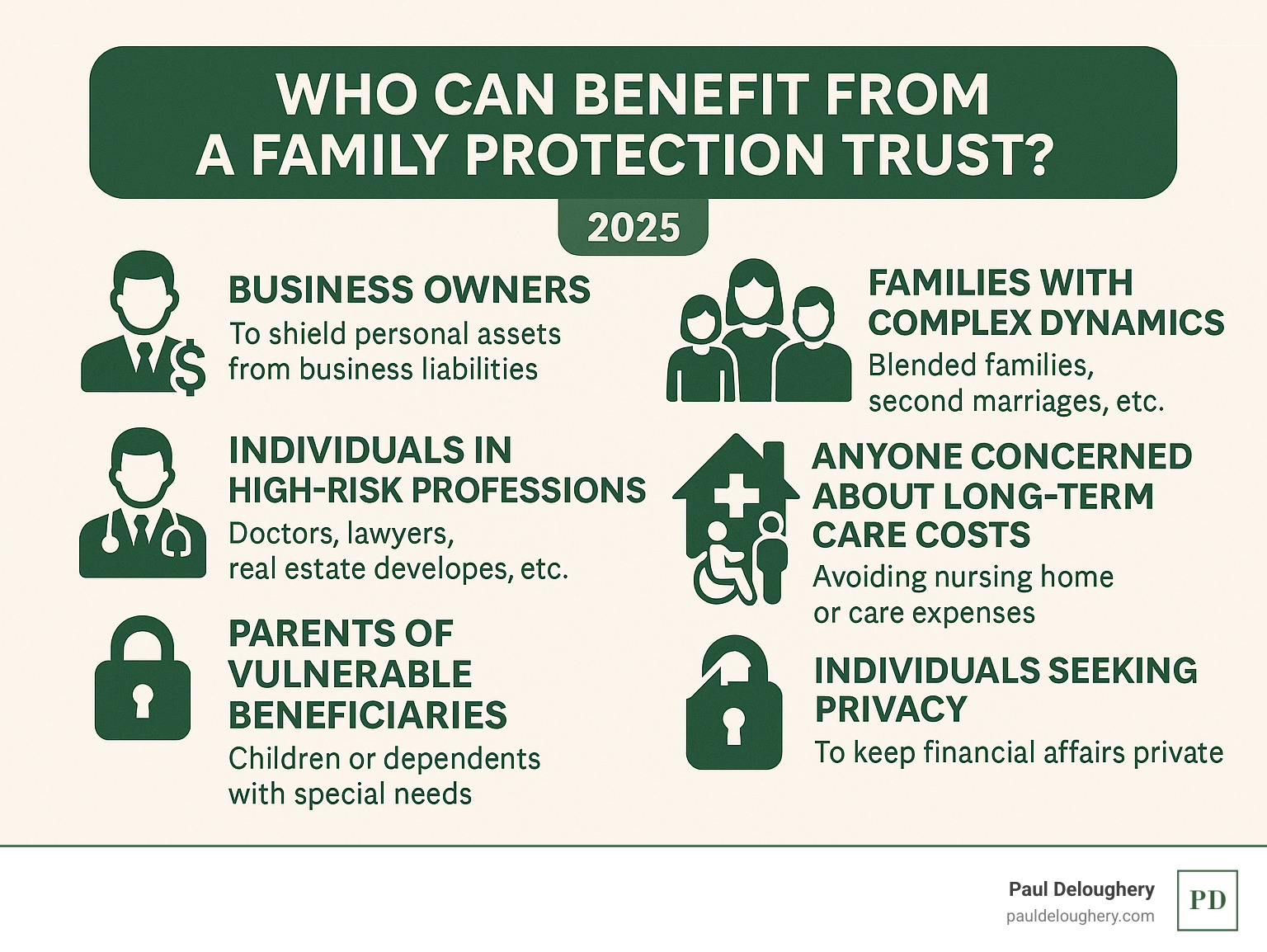
A family protection trust serves a broad audience, including:
- Business owners seeking to shield personal assets from business liabilities.
- Individuals in high-risk professions like doctors and lawyers who need protection from potential lawsuits.
- Families with complex dynamics, such as blended families or second marriages.
- Parents of vulnerable beneficiaries who need to provide long-term support without jeopardizing government benefits.
- Anyone concerned about long-term care costs or seeking privacy by avoiding probate.
Choosing the Right Trustees for Your Family Protection Trust
Selecting your trustee is one of the most critical decisions you’ll make. This person or institution is bound by a fiduciary duty to act with complete loyalty and prudence.
- Family Members or Friends: They bring personal knowledge of your values but must be prepared for the significant administrative and legal responsibilities.
- Professional Trustees: Trust companies or banks offer expertise in management, tax compliance, and legal requirements, providing impartiality and continuity for a fee.
- A Combination Approach: Many families use a hybrid model, such as a family member serving alongside a professional co-trustee, to get the best of both worlds.
Complete trust in your chosen trustee is non-negotiable. This decision is a cornerstone of effective Family Succession Planning.
Frequently Asked Questions about Family Protection Trusts
Can a family protection trust shield my home from care costs?
This is complex and depends on timing and intent. Transferring assets into a trust when long-term care is on the horizon can be challenged as a “deliberate deprivation of assets.” In the U.S., Medicaid has a five-year look-back period to scrutinize such transfers. If you apply for Medicaid within that window, you could face significant penalties that delay your eligibility.
The key is to plan ahead. A properly structured irrevocable family protection trust can offer protection, but it must be established well in advance of needing care, when you are healthy and care is not foreseeable. The government scrutinizes your motivation, so proactive planning with an experienced professional is essential.
How much does it cost to set up and maintain a trust?
Costs vary based on complexity. Setup costs for a comprehensive family protection trust typically range from $3,000 to $7,500, but can exceed $10,000 for intricate situations involving business assets or multi-generational goals.
Ongoing costs are also a factor. These include annual tax preparation fees (for Form 1041) and management fees if you use a professional trustee, which can range from 0.5% to 1.5% of trust assets annually. While significant, these costs are often far less than the potential expense of probate, lawsuits, or long-term care without a trust in place.
What happens if I put a mortgaged property into a trust?
This requires careful handling. Most mortgages contain a “due-on-sale” clause, which allows the lender to demand full repayment of the loan if you transfer the property’s ownership. This could create a sudden financial crisis.
While a federal law (the Garn-St. Germain Act) offers some protection for transfers to certain living trusts, it is not absolute. The smartest approach is to always get your lender’s written consent before making any transfer. Explain that it’s for estate planning purposes and you will continue making payments. For complex situations, specialized trusts like a Qualified Personal Residence Trust (QPRT) may be a better solution. Never attempt this transfer without consulting both your lender and your estate planning attorney.
Conclusion: Building an Enduring Legacy
Your legacy is more than money; it’s the values, memories, and opportunities you pass down. A family protection trust can be the foundation for this vision, but only as part of a comprehensive plan.
We’ve seen that a trust is a powerful instrument for Long-Term Wealth Preservation. It can shield assets from creditors, lawsuits, and care costs. However, its true power emerges when combined with family education and a shared understanding of the wealth’s purpose.
Statistics are sobering: roughly 70% of wealth transfers fail, not due to poor legal planning, but because heirs weren’t prepared. They lacked the skills to manage wealth or an understanding of the family values behind it.
True legacy planning goes beyond legal documents. It involves preparing your children to be responsible stewards of the wealth they inherit. It means having honest conversations about money, responsibility, and expectations. The most well-crafted family protection trust cannot succeed if family conflicts or unprepared heirs derail your vision.
This holistic approach is at the heart of what we do. We create plans that protect both your wealth and your family relationships, ensuring your legacy endures for generations. Ready to build a strategy that truly protects your family’s future? Explore our approach to asset protection and let us help you create a legacy that lasts.