
Family support for addiction recovery: 5 Powerful Positive Strategies 2025
The Family’s Role in Healing Addiction
Family support for addiction recovery is crucial for successful long-term sobriety. Research shows that when families actively participate in the recovery process, individuals are:
- 50% less likely to relapse compared to those without family involvement
- More likely to complete treatment programs
- Less likely to be hospitalized during recovery
- Better equipped to maintain long-term sobriety
Addiction doesn’t just affect the individual—it impacts the entire family system. When one member struggles with substance use disorder, everyone experiences the ripple effects through strained relationships, financial difficulties, emotional turmoil, and sometimes even physical health problems.
I’m Paul Deloughery, an attorney with 25 years of experience helping families steer difficult transitions, including supporting loved ones through family support for addiction recovery processes that protect both the individual’s health and the family’s well-being.
Family support for addiction recovery terms to learn:
- Addiction and family relationships
- Addiction counseling for families
- Addiction intervention strategies
Why Family Support for Addiction Recovery Works
When we think about addiction, it’s important to see the bigger picture. It’s not just an individual struggling alone – it’s a condition that ripples through entire families. The research is clear: recovery outcomes improve dramatically when loved ones actively participate in the healing journey.
A fascinating study on compassionate caregiving shows that the support families provide for addiction mirrors what helps people manage other chronic conditions like diabetes or heart disease. We wouldn’t expect someone managing diabetes to handle everything alone – why should addiction recovery be any different?
The numbers tell a powerful story: individuals with strong family support experience up to a 50% reduction in relapse rates. That’s not just a small improvement – it’s life-changing.
Role of Family Support in Addiction Recovery
Family support for addiction recovery creates a foundation that many people simply can’t build alone. When families get involved, they provide something essential: a safety net of understanding and encouragement during the inevitable ups and downs of recovery.
Think about the practical side, too. Family members often help with rides to appointments, creating substance-free environments, and gently reinforcing treatment goals. This kind of everyday support makes a measurable difference – people with family involvement show significantly better treatment adherence and experience fewer hospitalizations.
As one counselor shared with me recently, “I can almost always tell which clients have supportive families behind them. They simply have more emotional resources to draw from when things get tough – and in recovery, things always get tough at some point.”
How Addiction Impacts the Entire Family System
Addiction creates waves that touch everyone in a family. When one person struggles with substance use, others often unconsciously adopt specific roles to cope with the chaos:
Some become caretakers, constantly protecting the person from consequences. Others might become “heroes,” working overtime to bring positive attention to the family. Some family members act out and become scapegoats, while others withdraw completely or use humor to diffuse tension.
These shifting roles come with real health consequences. Family members of people with substance use disorders experience higher rates of anxiety, depression, and stress-related conditions. The financial strain can be enormous – from legal troubles to treatment costs to lost employment opportunities. Perhaps most painfully, addiction often erodes trust within families, creating wounds that need their own healing process.
Understanding these impacts helps us see that family support for addiction recovery isn’t just about helping the person with addiction – the whole family needs support and healing.
Debunking Myths: Tough Love, Codependency, Rock Bottom
Let’s clear up some harmful misconceptions that continue to circulate despite evidence to the contrary:
First, families don’t cause addiction. While family dynamics can contribute to risk factors, addiction develops through a complex mix of genetics, environment, trauma, and other influences. Blaming families only increases shame and reduces effective support.
Second, the “tough love” approach suggesting people need to “hit rock bottom” before recovery can begin is not just outdated – it’s dangerous. Research consistently shows that compassionate, consistent support leads to better outcomes than harsh ultimatums or abandonment. In fact, pushing someone away through “tough love” can actually increase overdose risk by removing potential early intervention.
Third, supporting a loved one through addiction doesn’t make you “codependent.” This term, which was actually rejected from the DSM-III, often pathologizes normal compassion. Helping a family member steer treatment isn’t enabling – it’s appropriate caregiving for a chronic health condition.
Finally, family involvement doesn’t necessarily mean formal therapy (though that can be valuable). Family support for addiction recovery exists on a spectrum from simple communication strategies to more intensive interventions. The key is finding approaches that fit your family’s unique circumstances and needs.
By embracing evidence-based approaches to family support, we can move beyond these harmful myths and create healing environments where recovery can flourish.
Evidence-Based Family Interventions and Therapies
When it comes to healing from addiction, families don’t have to figure it out alone. Research has shown us what works, giving families real tools that make a difference in recovery outcomes.

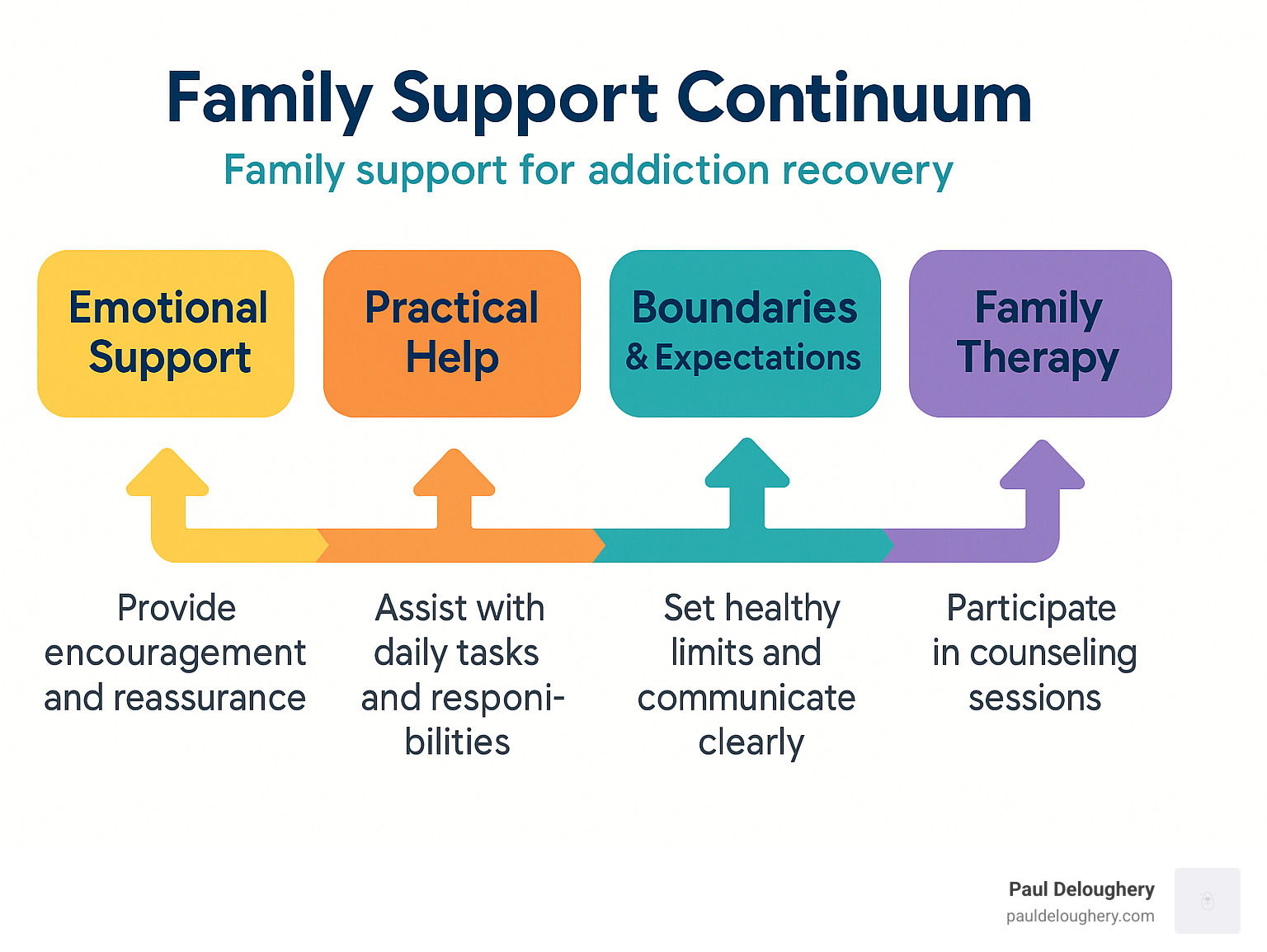
Continuum of Engagement: Informal Support → Formal Therapy
Family support for addiction recovery doesn’t have to be all-or-nothing. Think of it more like a spectrum where you can find the right fit for your family’s unique situation.
On the simpler end, informal support might look like regular check-ins, creating a substance-free home, or learning about addiction together. Many families start here, offering emotional encouragement while educating themselves about the recovery journey.
Moving along the spectrum to moderate engagement, families might participate in treatment planning meetings or attend psychoeducation sessions. This middle ground often includes learning essential communication skills and setting healthy boundaries that support recovery without enabling unhealthy behaviors.
For families ready for more structured help, formal therapeutic models offer evidence-based approaches with impressive success rates. Behavioral Couples Therapy (BCT) helps improve relationship functioning through “recovery contracts” that benefit both partners. The Community Reinforcement and Family Training (CRAFT) approach has been remarkably successful at encouraging treatment-resistant loved ones to seek help.
For families with teens struggling with substances, Multidimensional Family Therapy (MDFT) addresses substance use within broader contexts of family, peer relationships, and community influences. Brief Strategic Family Therapy (BSFT) and Family Behavior Therapy (FBT) round out the options with decades of research supporting their effectiveness.
The beauty of this continuum is flexibility. You can choose the right level based on your family’s time constraints, financial resources, cultural considerations, and the preferences of your loved one in recovery. With telehealth options now widely available, even family members living far away can participate meaningfully in the recovery process.
Harm Reduction & Healthy Boundaries
Recovery rarely follows a straight line, and family support for addiction recovery sometimes means embracing harm reduction approaches that meet your loved one where they are while keeping everyone safer.
Learning overdose prevention can literally save lives. Family members trained to administer naloxone (Narcan) gain not just practical skills but also peace of mind. Studies show that family members who receive this training demonstrate significantly better knowledge and confidence in responding to potential overdoses.
Understanding medication-assisted treatment (MAT) is another crucial aspect of harm reduction. Rather than viewing medications like methadone or buprenorphine as “substituting one drug for another,” informed families recognize these as evidence-based treatments that significantly improve recovery outcomes.
Perhaps most importantly, setting healthy boundaries protects everyone’s wellbeing while maintaining connection. Unlike harsh ultimatums, thoughtful boundaries might sound like: “I won’t provide cash, but I’ll help pay for treatment directly” or “I can’t be around you when you’re using, but I’ll always answer when you call about getting help.”
These boundaries aren’t about punishment—they’re about creating a sustainable way to offer family support for addiction recovery without enabling harmful behaviors or sacrificing your own mental health in the process.
Learning these skills doesn’t happen overnight, but resources like Addiction Counseling for Families can provide guidance in a supportive environment. The scientific research on family-based approaches consistently shows that when families learn and apply these evidence-based strategies, everyone benefits—not just the person in recovery.
Practical Guide: Communication, Boundaries, Self-Care
The journey of family support for addiction recovery begins with how we talk to each other. The words we choose can either build bridges of understanding or create walls that separate us when we need connection most.

Family Support for Addiction Recovery Communication Toolkit
When supporting a loved one through recovery, how we communicate makes all the difference. Family support for addiction recovery works best when we speak with compassion and clarity.
The language we use matters deeply. Rather than labeling someone an “addict” or “alcoholic,” which reduces them to their condition, try saying “person with substance use disorder.” This small shift acknowledges their humanity first. Similarly, terms like “clean” or “dirty” carry judgment—instead, say “in recovery” or “actively using.”
Motivational interviewing techniques can transform difficult conversations. Instead of asking, “Don’t you think you should stop drinking?” try an open-ended approach: “What concerns do you have about your drinking?” This invites reflection rather than defense. When your loved one shares something difficult, respond with empathy: “That sounds really challenging. I can see why you’re struggling.”
Reflective listening shows you truly hear them. Try paraphrasing what they’ve shared: “It sounds like you’re feeling overwhelmed by all these treatment requirements.” This validation creates safety, even when you disagree with certain behaviors.
When expressing your own concerns, frame them with “I” statements. “I feel worried when you come home late without calling because I care about your safety” feels very different from “You always make me worry by staying out late.” The first invites conversation; the second provokes defensiveness.
Sometimes, the simplest approach works best. Research shows that a gentle “Can we talk?” can effectively open conversations about substance use concerns without triggering immediate resistance.
Self-Care & Mental Health for Family Members
Supporting someone through addiction recovery can feel like an emotional marathon. Many family members experience chronic stress, anxiety, depression, and even secondary trauma. Some describe feeling isolated as they pour energy into their loved one while neglecting their own needs.
Remember: self-care isn’t selfish—it’s necessary for sustainable support.
Support groups provide invaluable connection with others who truly understand. Al-Anon and Nar-Anon offer peer support specifically for families affected by alcohol or drug use. SMART Recovery Family & Friends provides a science-based alternative, while Parents of Addicted Loved Ones (PAL) focuses on the unique challenges parents face.
Individual therapy gives you space to process your own emotions and learn healthy coping strategies. A good therapist can help you identify enabling behaviors and develop resilience skills custom to your situation.
Daily self-care practices matter tremendously. Prioritize sleep, nutrition, and exercise to maintain your physical health. Set aside time for activities you enjoy, even if just for 15 minutes daily. Practice mindfulness to stay grounded when emotions run high. Most importantly, maintain connections with supportive friends who can offer perspective and relief.
Be mindful of information boundaries too. Constantly reading addiction horror stories or conflicting recovery advice can increase anxiety without adding value. Every recovery journey is unique—what worked for someone else’s family may not be right for yours.
For more guidance on navigating challenging family dynamics during recovery, our guide on Handling Family Conflict offers practical strategies.
Relapse Prevention & Long-Term Support
Recovery isn’t a sprint—it’s a marathon requiring evolving support over time. The family’s role shifts as recovery progresses, but never disappears.
Creating a family relapse prevention plan helps everyone prepare for challenges. Work together to identify personal triggers and warning signs, then develop clear communication protocols for high-risk situations. Decide in advance how you’ll respond if relapse occurs, focusing on learning rather than punishment. This planning turns potential crises into manageable challenges.
Regular “family check-ups” help maintain healthy dynamics. Schedule time every few weeks to discuss how recovery is affecting everyone. Revisit boundaries and adjust as needed—what worked in early recovery might need refinement later on. Celebrate milestones together, no matter how small. These check-ins catch emerging issues before they become major problems.
Supporting healthy lifestyle changes creates a foundation for lasting recovery. Join your loved one for substance-free activities that create new positive associations. Make your home environment conducive to recovery by removing triggers and adding comforts. Model healthy coping mechanisms for stress and disappointment. Encourage connections with positive peer influences who support their recovery journey.
Recovery needs change over time. Remain vigilant about potential triggers even years into recovery, especially during major life transitions. Maintain connections to support systems that can provide perspective when needed. Develop family resilience strategies that strengthen your ability to face challenges together.
For more specific guidance on supporting a loved one through various stages of recovery, our resource on Addiction Intervention Strategies provides detailed approaches for different situations.
Resources and Support Networks
No family should have to steer addiction recovery alone. Thankfully, there’s a wealth of resources available to provide guidance, support, and community during this challenging journey.

When seeking help, it’s important to understand the different types of support available. Peer support groups like Al-Anon and Nar-Anon offer free, widely available connections with others who truly understand your experience. While they’re not professional treatment and group quality can vary, they excel at providing emotional support and reducing that sense of isolation many families feel.
Family therapy, on the other hand, provides professional guidance through evidence-based approaches custom to your specific family dynamics. Though it involves costs, time commitments, and sometimes insurance problems, it’s invaluable for resolving deep-rooted issues and improving communication patterns that may have deteriorated during active addiction.
For families who want structured learning, educational programs offer skill-building opportunities based on evidence-informed practices. While they might not address all emotional needs and availability can be limited in some areas, they’re excellent for understanding addiction and learning practical strategies you can implement right away.
Many families also benefit from online communities that provide 24/7 access with the option of anonymity. The convenience is undeniable, especially for those with geographic barriers or scheduling challenges. Just be mindful that quality varies, and these work best as supplemental support rather than your only resource.
Finding Local & Virtual Help
When my clients ask where to start looking for help, I often recommend national hotlines as an entry point. SAMHSA’s National Helpline (1-800-662-HELP) can connect you with local resources custom to your situation. The National Association for Children of Addiction (1-888-554-COAS) offers specialized support for families where children are affected, while the Partnership to End Addiction Helpline (1-855-378-4373) provides personalized guidance for parents and caregivers.
The digital world has made finding help easier than ever. SAMHSA’s Treatment Locator (findtreatment.samhsa.gov) and the Addiction Resource Hub (findtreatment.gov) can help you locate appropriate services in your area. For those who can’t attend in-person meetings, virtual recovery meetings are available through platforms like intherooms.com.
Family support for addiction recovery also includes harm reduction resources that can literally save lives. Naloxone (Narcan) access through naloxoneforall.org, harm reduction supplies via Next Distro (nextdistro.org), and the Never Use Alone hotline (1-800-484-3731) provide critical tools for families supporting loved ones who may still be using substances.
Families facing specific challenges can find specialized support. Grandparents or other relatives raising children affected by addiction can connect with kinship care resources at grandfamilies.org. Those navigating legal complications can find assistance through the American Bar Association, while families experiencing financial strain can explore assistance programs at needhelppayingbills.com.
What’s particularly encouraging is that most of these resources now offer virtual options, making support accessible regardless of where you live or transportation limitations you might face.
Clinician Tips to Engage Families
In my work with treatment providers, I’ve seen how certain engagement strategies can dramatically improve family participation in the recovery process.
Early involvement makes a tremendous difference. Treatment centers that invite family members to initial assessment sessions, provide dedicated phone lines for family questions, and offer facility tours help reduce the anxiety that often surrounds the treatment process.
Thoughtful questioning can identify key supporters in a person’s life. Simple questions like “Who do you go to for support?” or “Who has been the most helpful person in your life?” help clinicians identify and engage the most influential people in a client’s support network.
Practical considerations matter too. Family support for addiction recovery increases when providers offer evening or weekend sessions, provide childcare during family therapy, use telehealth options, and address cultural and linguistic needs. These seemingly small accommodations can make the difference between a family engaging in treatment or not.
Educational resources round out the support package. Family information packets, multimedia resources like videos and podcasts, and graduated learning opportunities help families absorb information at their own pace while building their knowledge base.
For families navigating particularly complex dynamics during recovery, our Family Disputes Resolution services can provide additional support when tensions run high or communication breaks down.
Reaching out for help isn’t a sign of weakness—it’s a powerful step toward healing for the entire family. The right support network can make all the difference in your family’s recovery journey.
Frequently Asked Questions about Family Support for Addiction Recovery
What are healthy boundaries that avoid enabling?
One of the most challenging aspects of supporting a loved one through addiction recovery is knowing where to draw the line between helpful support and harmful enabling.
Healthy boundaries protect your wellbeing while still showing love and care. Enabling, on the other hand, shields your loved one from experiencing the natural consequences of their addiction—which ultimately can prevent them from recognizing the need for change.
Think of boundaries as guardrails, not walls. They guide both you and your loved one toward healthier interactions. For example, instead of giving money directly (which might fund substance use), you might say: “I won’t provide cash, but I’m happy to pay for your treatment program or necessary bills.” This shows you care while avoiding actions that might inadvertently support continued substance use.
Other meaningful boundaries might include: “I won’t make excuses to your employer when you’re unable to work, but I’ll help you have that difficult conversation if you’re ready to be honest.” Or “I need to leave when you’re actively using, but I’m just a phone call away when you want to talk about recovery options.”
Boundaries aren’t about controlling the other person—they’re about clarifying what you will and won’t do. The most effective boundaries are clearly communicated, consistently maintained, and occasionally revisited as recovery progresses.
How can family involvement help prevent relapse?
Family support for addiction recovery creates a powerful safety net that significantly reduces relapse risk. When families stay engaged in the recovery process, they become an early warning system that can spot potential problems before they escalate into full relapse.
Picture this: A mother notices her son becoming increasingly withdrawn and irritable—behaviors she now recognizes as early warning signs. Rather than waiting until he relapses, she can gently check in: “I’ve noticed you seem stressed lately. Is there something we should talk about?” This simple conversation might be enough to help him reconnect with his support system when he needs it most.
Beyond early detection, families provide accountability without judgment. Regular family check-ins create a sense of responsibility that can strengthen recovery commitments. And because addiction thrives in isolation, the connection that families provide serves as a powerful counterforce to the pull of substance use.
The home environment itself matters tremendously. Families can create spaces that minimize triggers and maximize support—whether that’s keeping alcohol out of the house or ensuring there’s always healthy food available when stress might otherwise trigger cravings.
Many people don’t realize that everyday stressors often trigger relapse. Supportive families can help manage practical challenges like transportation to appointments, childcare during treatment, or navigating insurance paperwork—removing barriers that might otherwise derail recovery efforts.
Studies consistently show that when families actively participate in the recovery journey, their loved ones experience fewer relapses, better treatment adherence, and stronger long-term recovery outcomes.
Which therapy model best fits our family?
Finding the right therapeutic approach for your family is like finding the right key for a lock—what works beautifully for one family might not fit another’s needs. The good news is that several evidence-based models exist, each designed for specific situations.
If you’re in a committed relationship where one partner struggles with substance use, Behavioral Couples Therapy (BCT) might be your best option. Research consistently shows BCT outperforms individual treatment alone, improving both relationship satisfaction and sobriety outcomes. It helps couples create “recovery contracts” and rebuild trust damaged by addiction.
For families with teenagers facing substance challenges, specialized approaches like Multidimensional Family Therapy (MDFT) or Brief Strategic Family Therapy (BSFT) address the unique needs of adolescent development while strengthening family bonds. These models recognize that teen substance use often connects to family dynamics, peer relationships, and school performance.
When your loved one resists treatment altogether, Community Reinforcement and Family Training (CRAFT) offers hope. This approach teaches family members skills to encourage treatment entry while improving their own wellbeing—whether or not their loved one seeks help. Studies show CRAFT successfully engages previously treatment-resistant individuals about 70% of the time.
Families with limited time or resources might benefit from brief interventions like Family Psychoeducation or Solution-Focused Brief Therapy, which can provide significant benefits in fewer sessions. Meanwhile, complex family systems with multiple challenges might need the comprehensive approach of Multisystemic Therapy (MST).
A qualified family therapist can help assess which model aligns best with your family’s unique circumstances, cultural background, and recovery goals. Often, the best approach is starting with the least intensive intervention that meets your needs, then adjusting if necessary.
Seeking help for your family isn’t a sign of weakness—it’s a profound act of courage and love that can transform your family’s future.
Conclusion
Supporting a loved one through addiction recovery isn’t just a matter of duty—it’s a profound journey that transforms both the individual struggling with substance use and the family surrounding them. As we’ve seen throughout this guide, family support for addiction recovery creates a powerful foundation for healing, significantly improving the chances of sustained sobriety and renewed family bonds.

At Paul Deloughery, we understand that addiction recovery extends far beyond simply addressing substance use. The real work involves rebuilding trust, establishing healthier patterns of interaction, and creating what I like to think of as a “legacy of healing” that can positively influence generations to come. This perspective aligns perfectly with our broader mission—just as we help families preserve their financial legacies through thoughtful estate planning, supporting a loved one’s recovery helps preserve the emotional and relational legacies that ultimately matter most.
Recovery isn’t a straight line with a clear finish line—it’s more like a winding path with hills and valleys along the way. There will be setbacks, challenging days, and moments of doubt. But with consistent, compassionate support, families can steer this journey together, growing stronger with each obstacle overcome. The skills you’re developing now—improved communication, healthy boundary-setting, intentional self-care, and emotional resilience—will continue serving your family long after the acute phase of recovery has passed.
I’ve seen how families who stick together through the recovery process often emerge with deeper connections and a newfound appreciation for one another. The shared experience of overcoming such a significant challenge creates bonds that are difficult to break.
Please don’t hesitate to reach out to the resources mentioned throughout this guide. No family should face addiction alone, and with the right support network, your family can not only survive this challenge but thrive in its aftermath. The journey may not be easy, but I promise you—it’s worth it.
For more information about resources available to families navigating addiction recovery, please visit our Resources page.