
Generational Wealth Planning: 3-Gen Success
The Great Wealth Transfer: Why Your Family’s Future Depends on Planning Today
Generational wealth planning is the strategic process of building, preserving, and transferring assets—along with family values—across multiple generations. Effective planning involves building a financial foundation, creating a legal structure with wills and trusts, preparing heirs for their responsibilities, minimizing taxes, and establishing strong family governance.
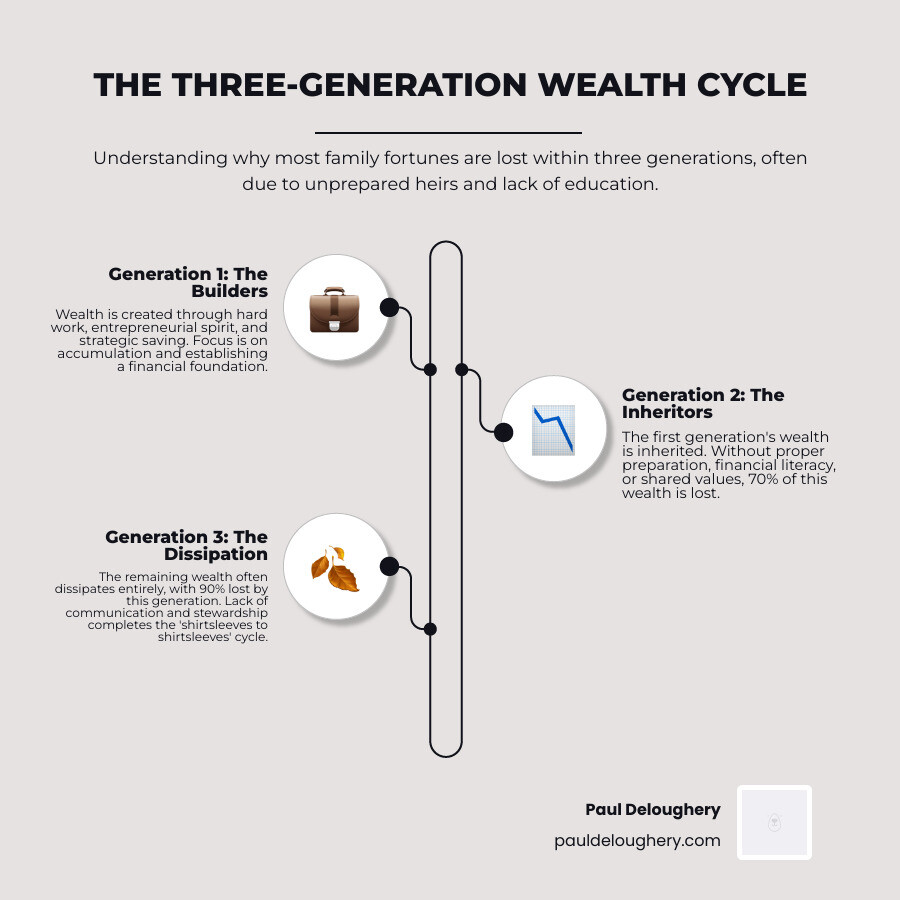
The urgency for this has never been greater. We are witnessing the largest wealth transfer in history, with roughly $84 trillion in assets expected to change hands over the next 20 years. Yet, the statistics are sobering: 70% of wealthy families lose their wealth by the second generation, and 90% lose it by the third.
This isn’t just about money; it’s about creating opportunities for your children and grandchildren while preserving the values that built your family’s success. The most common reason for failure isn’t poor investments, but unprepared heirs. As one financial advisor noted, “70 percent of wealth transfers fail because heirs aren’t ready for the responsibility.”
I’m Paul Deloughery, an attorney with 25 years of experience in estate planning and probate law. I’ve helped hundreds of families steer the complexities of generational wealth planning, and I’ve seen how the right strategies can preserve both assets and family harmony for generations.
The Foundation: What is Generational Wealth and Why Does it Matter?

Think of generational wealth planning as planting an oak tree. You may not sit in its shade, but your children and grandchildren will. It’s about creating something that grows stronger with time, providing opportunity for generations to come.
Defining Your Family’s Legacy Beyond Assets
While generational wealth includes financial assets, real estate, business ownership, and intellectual property, a true legacy is built on more than money. The families who succeed long-term understand this. Family values are the principles that guide decisions and responsibilities. Education—both formal and financial—is a powerful wealth-building tool. And philanthropy teaches the next generation that wealth comes with a responsibility to give back, uniting the family in a shared purpose.
This comprehensive approach goes beyond traditional estate planning. You can find more info about Legacy Planning Advice to see how we help families define what truly matters.
The Tangible Benefits of a Long-Term Plan
Thoughtful generational wealth planning provides more than just money in the bank. It creates financial security that acts as a safety net, helping to break poverty cycles and weather unexpected storms. It allows you to fund education so your heirs can start their careers without debt, free to pursue their passions. This stability also fosters entrepreneurship, providing the capital for family members to innovate and take smart risks. It gives your heirs the flexibility to pursue their passions, whether in art, education, or community leadership, without sacrificing their financial future.
This is increasingly important as the financial landscape changes. By 2030, American women are expected to control much of this wealth, highlighting the need for inclusive planning.
Common Challenges and Why Most Families Fail
The uncomfortable truth is that most families fail at this. The 70% statistic represents real families whose legacies crumbled. The primary culprits are human, not financial:
- Communication breakdown: Parents avoid talking about money, leaving the next generation unprepared.
- Unprepared heirs: Heirs who inherit wealth without understanding the responsibility that comes with it often lose it quickly.
- Lack of trust: When parents don’t share information, children feel shut out, leading to resentment and conflict.
- Differing values: Without open dialogue, generational differences in philosophy can tear a family apart.
- No shared family vision: Without a clear purpose for the wealth, everyone pulls in different directions, leading to waste and conflict.
These challenges show why success requires more than legal documents; it demands honest conversations and careful preparation. Our Family Succession Planning services help families steer these complex dynamics.
Key Strategies for Building and Growing Your Wealth

Building wealth that lasts for generations requires patience, strategy, and consistent care. The key is to start, no matter your current situation, and remain committed to the process.
Creating a Strong Financial Baseline
Before you can build a legacy, you need a solid financial foundation. This starts with mastering the basics: budgeting to control your cash flow, debt reduction to stop leaks in your financial bucket, and building an emergency fund to handle life’s unexpected events without derailing your long-term goals. Developing sensible spending habits is about making intentional choices that prioritize your family’s future.
Here are 3 initial steps to get started:
- Track every dollar you spend for one month to see where your money is really going.
- Create a realistic budget that treats savings as a non-negotiable expense.
- Automate your savings to pay your future self first.
Investing for the Long Haul
Once your finances are in order, investing becomes the engine for your generational wealth planning. Thanks to compound interest, your money can work for you; at a 10% annual return, $100,000 can grow to $1.6 million over 28 years. Diversification across stocks, bonds, and real estate is crucial to protect your portfolio from market downturns. Adopting a long-term perspective helps you avoid panic-selling during market dips.
Strategies must also be flexible. In 1990, technology was just 6.3% of the S&P 500; today, it’s over 29%. Adapting to market changes is essential for long-term success. We help families develop investment strategies designed to last for generations. You can learn more about our Strategies for Protecting and Preserving Wealth.
The Role of Business Ownership and Life Insurance
Beyond stocks and bonds, business ownership is a powerful wealth-building tool, creating both income and equity that can grow for decades. However, a family business requires careful succession planning to ensure it transfers successfully to the next generation.
Whole life insurance is another valuable tool in generational wealth planning. It builds cash value you can access during your lifetime, and its death benefit passes to beneficiaries tax-free, making it an efficient way to transfer wealth. For business owners, integrating the company into your estate plan is critical. Our Estate Planning for Business Owners services help ensure your business becomes a cornerstone of your legacy.
The Blueprint: Your Guide to Generational Wealth Planning

Effective generational wealth planning requires a detailed blueprint. This plan combines legal structures, tax strategies, and protective measures to ensure your legacy endures.
Crafting Your Core Estate Plan
Your core estate plan is the foundation. These documents are not just paperwork; they are the tools that protect everything you’ve built.
- Will: Specifies how your assets are distributed and names guardians for minor children.
- Trusts: A trust is like a protective vault for your assets, offering control over how and when wealth is distributed to beneficiaries. Trusts also provide privacy, as they avoid the public probate process, and can offer significant tax advantages.
- Powers of Attorney: These documents appoint someone you trust to make financial and healthcare decisions if you become incapacitated.
- Beneficiary Designations: Naming beneficiaries on retirement accounts and life insurance policies allows those assets to pass directly to loved ones, bypassing probate.
We tailor these tools to fit your unique family situation. Explore our Estate Planning Services to learn more.
The Dangers of DIY Probate Avoidance in Generational Wealth Planning
Many people try to avoid the time and expense of probate, but DIY strategies often backfire disastrously. I’ve seen well-intentioned parents accidentally disinherit their own children, especially in blended families. For example, adding a new spouse as a joint owner on a house may seem simple, but it can mean the children from a prior marriage get nothing.
The real danger is focusing on probate avoidance while ignoring the second and third-order consequences. Adding a child as a joint owner on a bank account might avoid probate, but it also exposes that money to the child’s creditors or a divorce settlement. These mistakes can tear families apart, leading to legal battles and broken relationships that proper planning could have prevented. Strategic probate avoidance requires professional guidance to ensure your assets are protected and your wishes are honored. Our Asset Protection Planning services help you steer these complexities safely.
Navigating Legal and Tax Considerations in Generational Wealth Planning
While taxes are a certainty, their impact can be dramatically reduced with smart planning. Estate taxes apply upon death, and while the federal exemption is high ($13.61 million in 2024), it’s scheduled to be cut in half after 2025. Gift taxes apply to lifetime transfers, but strategic gifting can move wealth efficiently. The Generation-Skipping Transfer (GST) tax is a 40% tax designed to prevent families from skipping a generation to avoid estate taxes, but it can be managed with advanced trusts.
Capital gains taxes on appreciated assets can also be minimized with proper planning, often through a “step-up” in cost basis at death. Irrevocable trusts are powerful tools for minimizing these taxes while protecting assets from creditors. Tax laws change, so staying current is vital. We help clients implement strategies that work today and adapt for tomorrow. For official information, you can always Learn more about the latest tax rules from the IRS.
Preparing Your Heirs: The Human Side of a Lasting Legacy

Most generational wealth planning failures aren’t caused by bad investments; they happen because the heirs weren’t prepared to receive the wealth. You wouldn’t hand over the keys to a high-performance car without driving lessons, yet many families pass on significant assets to heirs with no financial training.
Why Heir Preparation is the Key to Success
The statistic that 70% of wealth transfers fail is a direct result of unprepared heirs. Successful planning prepares the people, not just the portfolio. This means focusing on the human elements that give wealth meaning. It starts with instilling family values—the principles of hard work, integrity, and generosity that guided you. Sharing family history, including the struggles and sacrifices made to build the wealth, fosters a deep sense of appreciation. Finally, defining the purpose of the wealth helps heirs see their role as stewards, not just beneficiaries. The goal is to cultivate stewardship over entitlement, ensuring the wealth is seen as a tool for collective benefit.
We help families develop Family Governance & Legacy Leadership strategies to address these crucial human elements.
Fostering Financial Literacy Across Generations
Even successful adults can be financially illiterate when it comes to managing a large inheritance. Family meetings, often facilitated by a neutral third party, create a safe space for open conversations about finances, values, and goals. Financial education should begin with age-appropriate money lessons and evolve as children mature. Open communication about wealth breaks down the secrecy that breeds anxiety and poor decisions. Involving children in philanthropy teaches them that money is a tool for good. Above all, leading by example is the most powerful teacher of responsible financial behavior.
Bridging Generational Gaps in Values and Goals
Every generation has a different worldview, which can be a strength if managed well. Different investment philosophies may arise, with younger generations favoring ESG or impact investing. Philanthropic priorities and career paths may also vary. Instead of viewing these as conflicts, successful families find common ground and accommodate different approaches within a unified strategy. A skilled advisor can act as a bridge between generations, facilitating conversations to build unity around shared core values while respecting individual differences. Your wealth is more than money; it’s a reflection of your family’s journey. Preparing your heirs to receive the wisdom behind the assets is the greatest gift you can give.
Frequently Asked Questions about Generational Wealth Planning
Planning for your family’s future brings up many questions. Here are answers to the most common concerns I’ve heard in my 25 years of practice.
What is the first step in creating a generational wealth plan?
The first step isn’t about numbers; it’s about defining what wealth and legacy mean to your family. This involves honest conversations about your values, vision, and goals. Ask yourself: “What do we want our wealth to do?” Answering this question provides the “why” behind your plan and guides every subsequent legal and financial decision.
How much money do I need to start planning for generational wealth?
Generational wealth planning is a mindset, not a dollar amount. It’s a strategy any family can adopt, regardless of their current net worth. The core principles—sensible financial habits, strategic thinking, and teaching the next generation about financial responsibility—are universal. You can start building that foundation today with a basic estate plan and a commitment to financial education.
How do I talk to my family about our wealth and inheritance?
This is a common challenge. The key is to start early and have ongoing conversations. Frame the discussions around family values, opportunities, and responsibilities, not just dollar amounts. Family meetings, sometimes facilitated by a neutral advisor, create a safe space for open dialogue and education. Transparency helps ensure that when heirs inherit wealth, they are prepared to manage it wisely.
Conclusion: Building a Legacy That Lasts
Successful generational wealth planning weaves together financial assets with strong values. Families who succeed don’t just pass down money; they pass down wisdom, purpose, and a deep understanding of what their wealth represents.
This requires prepared heirs who understand their role as stewards. It’s the difference between giving someone a fish and teaching them to fish—while also explaining why fishing matters to your family.
This is a continuous journey, not a one-time event. Laws change, families evolve, and plans must be reviewed and updated regularly. That’s why Paul Deloughery’s holistic approach is so effective. We integrate legal, financial, and educational strategies into a comprehensive framework that grows with your family, focusing on protecting assets and preserving family harmony.
The sobering statistics about wealth loss are not inevitable. They are the result of focusing only on the money and forgetting the people. Families who beat the odds communicate openly, prepare their heirs, and create a shared vision for their wealth.
Your family doesn’t have to be a cautionary tale. With thoughtful planning and professional guidance, you can create a legacy that provides security, creates opportunity, and reflects your most important values.
Start building your family’s lasting legacy with comprehensive Estate Planning Services and give your loved ones the gift of financial security and family unity for generations to come.