
Protecting Personal Assets From Business: 4 Vital Steps
Why Your Personal Wealth Is at Risk When You Own a Business
Protecting personal assets from business liabilities is one of the most critical challenges facing entrepreneurs. Without proper safeguards, a single lawsuit, unexpected debt, or business failure can expose your home, savings, and other personal property to creditors. Experience in estate planning and asset protection shows how a proactive strategy can safeguard a family’s legacy. The key is addressing these risks before a problem arises.
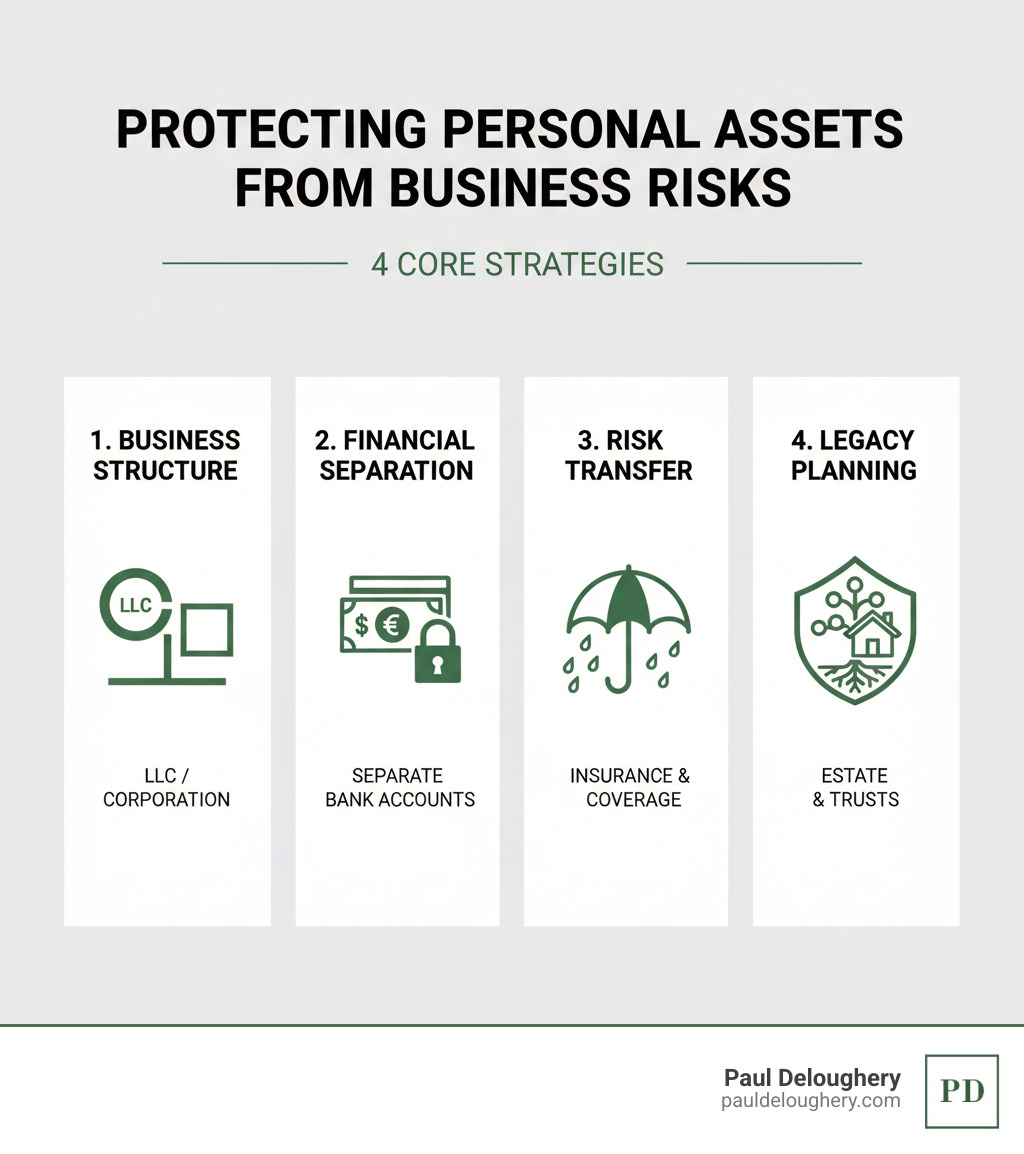
Quick Answer: 4 Core Strategies for Protecting Personal Assets from Business
- Choose the Right Business Structure – Form an LLC or Corporation to create legal separation between you and your business
- Maintain Strict Financial Separation – Use separate bank accounts and avoid commingling personal and business funds
- Transfer Risk Through Insurance – Secure comprehensive coverage including general liability, professional liability, and umbrella policies
- Integrate Asset Protection with Estate Planning – Use trusts and proper legacy structures to shield wealth from creditors while preparing heirs
The statistics are sobering. A significant percentage of small businesses face lawsuits annually, with the average liability suit costing over $50,000. If you operate as a sole proprietorship or general partnership, there is no legal separation between your personal and business assets, meaning creditors can pursue your home, car, and investments to satisfy business debts.
Many owners mistakenly believe forming an LLC or corporation is a permanent shield. However, courts can “pierce the corporate veil” and hold you personally liable if you fail to maintain corporate formalities or treat the business as a personal piggy bank. Protecting your assets requires a holistic approach that integrates your business structure with insurance, contracts, and your broader estate planning goals.
The Foundation: Choosing the Right Business Structure
Your business structure is the foundation of your asset protection strategy. It’s your first line of defense in protecting personal assets from business liabilities. The right structure builds a legal wall between your business and personal life. If the business faces a lawsuit or can’t pay its debts, that wall keeps creditors away from your home, savings, and retirement accounts.
But not all structures offer this protection.
Sole Proprietorships and General Partnerships
Starting as a sole proprietorship is easy—no paperwork, no filing fees. But this simplicity is dangerous. With a sole proprietorship or general partnership, you and your business are legally one and the same. There is no separation, which means you have unlimited personal liability for all business debts and lawsuits.
If your business is sued, creditors can seize your personal bank account. If a customer is injured, your family’s savings are on the line. While many businesses operate as sole proprietorships, popularity doesn’t equal safety. No asset separation means high risk.
Limited Liability Companies (LLCs) and Corporations
An LLC or corporation is a separate legal entity that can own property, sign contracts, and be sued—all without directly touching your personal assets. This separation is called the corporate shield. When maintained properly, it means creditors can generally only go after what the business owns. Your home and personal savings stay protected.
Both LLCs and corporations offer this limited liability protection to their owners (members in an LLC, shareholders in a corporation). The main differences relate to taxation and formalities, not the fundamental liability protection.
S Corps and C Corps are tax classifications for corporations; both shield shareholders from personal liability. An LLC can even elect to be taxed as an S Corp for flexibility. The bottom line is that if you’re serious about protecting personal assets from business risks, an LLC or corporation is essential.
Here’s how these structures stack up:
| Business Structure | Liability Protection | Cost to Set Up (Approx.) | Maintenance Requirements |
|---|---|---|---|
| Sole Proprietorship | None (unlimited) | Low | Minimal (business license, tax reporting) |
| General Partnership | None (unlimited, joint) | Low | Minimal (partnership agreement, tax reporting) |
| LLC | Limited (to investment) | Moderate | Moderate (state filings, operating agreement, separate funds) |
| Corporation | Limited (to investment) | Moderate to High | High (state filings, bylaws, board meetings, minutes, separate funds) |
Yes, forming an LLC or corporation requires more effort and cost, but that investment is small compared to the risk of losing your personal assets in a lawsuit. Get this foundational step right from the start.
Maintaining the Shield: Corporate Formalities and Financial Discipline
Forming an LLC or corporation is a powerful first step, but it’s not a one-time fix for protecting personal assets from business liabilities. Many business owners stumble here, assuming the “LLC” or “Inc.” after their name is an impenetrable fortress. The truth is, your corporate shield requires ongoing maintenance. Without consistent attention to corporate formalities and financial discipline, that protective barrier can crumble.

The Danger of “Piercing the Corporate Veil”
“Piercing the corporate veil” is a legal process where a court disregards your business’s separate status, allowing creditors to seize your personal assets to satisfy business debts. As research from QuickBooks highlights, you must act like a separate business, not just look like one on paper.
Courts pierce the veil when you treat the business as an “alter ego.” The most common triggers include:
- Failing to maintain corporate formalities: Skipping board meetings, not keeping minutes, or failing to issue stock for corporations. For LLCs, it could mean not having an operating agreement.
- Commingling funds: Mixing personal and business money.
- Under-capitalization: Not putting enough money into the business to operate properly.
These formalities aren’t busy work—they are proof that your business is a real, separate entity.
Avoiding Commingling: The Importance of Asset Separation
The single biggest mistake business owners make is commingling funds—mixing personal and business money. Paying your mortgage from the business account or buying office supplies with a personal card tells a judge there’s no real separation to protect. This makes your personal assets fair game in a lawsuit and raises red flags with the IRS.
The solution requires discipline:
- Open dedicated business bank accounts and use them exclusively for business transactions.
- Get business credit cards and use them only for company expenses.
- Pay yourself properly through a salary or formal owner’s draw, not by taking cash randomly.
Clean bookkeeping is not optional. It’s essential for legal protection and understanding your business’s financial health.
Mitigating Director and Officer Liability
Even with a solid corporate structure, directors and officers can face personal liability. The most common trap is unpaid payroll taxes. The IRS can hold you personally liable for the full amount if your business fails to remit withheld taxes. This statutory liability pierces any corporate shield.
Personal liability also applies to fraudulent or criminal acts conducted through the business. Additionally, directors have a fiduciary duty to act in the company’s best interest; breaching this duty can lead to personal lawsuits.
To protect yourself, maintain strict financial oversight and consider Directors and Officers (D&O) insurance. This coverage protects you from personal losses if you are sued for actions taken as a business leader. Consulting with legal and accounting professionals is crucial to steer these risks effectively.
Proactive Strategies for Protecting Personal Assets from Business Risks
Setting up the right business structure and keeping clean finances are your foundation. But protecting personal assets from business liabilities requires a multi-layered defense. Smart risk transfer, strategic contracts, and careful debt management add critical layers to your fortress, safeguarding your family’s wealth from the storms that business owners inevitably face.

Transferring Risk with Business Insurance
Insurance is a powerful tool for asset protection. You pay a premium, and the insurance company agrees to cover the financial fallout from a disaster, preventing a lawsuit from draining your personal savings.
Key coverage types include:
- General Liability Insurance: Your baseline protection against everyday risks like a customer slip-and-fall or property damage claims.
- Professional Liability (E&O) Insurance: Critical for service providers, this covers claims of negligence or errors that cause a client financial harm.
- Cyber Liability Insurance: Essential in the digital age, this covers costs related to data breaches, including notification, legal defense, and regulatory fines.
- Commercial Umbrella Insurance: As the National Association of Insurance Commissioners explains, this provides extra liability coverage that kicks in after your other policies are exhausted. It’s an inexpensive way to add a significant layer of protection.
A comprehensive insurance strategy is a cornerstone of wealth preservation. Review your coverage regularly as your business grows.
Using Contracts to Limit Personal Liability
Well-drafted contracts define the rules of engagement and can dramatically reduce your liability. Key provisions include:
- Indemnity Clauses: Require another party (like a manufacturer) to cover losses arising from their product or work, so you aren’t held responsible for their mistakes.
- Limitation of Liability Clauses: Cap potential damages, often to the amount paid for your service, preventing a small project from turning into a massive lawsuit.
- Arbitration Clauses: Keep disputes out of public court, making them private, faster, and often less expensive than litigation.
Crucially, always sign contracts in the name of your LLC or corporation, not your personal name, to maintain the corporate shield.
The Hidden Trap of Personal Guarantees
Personal guarantees are one of the fastest ways to demolish your asset protection. When you sign a personal guarantee for a business loan or lease, you are telling a lender, “If my business can’t pay, come after my personal assets.” This completely bypasses the liability protection of your LLC or corporation for that specific debt.
While sometimes unavoidable for new businesses, you should always negotiate the terms. Try to:
- Negotiate a dollar cap on the guarantee.
- Add a sunset clause that releases you after a certain time or when the business hits financial milestones.
- Insist on several liability if there are multiple owners, making you responsible only for your share.
Building strong business credit is the long-term solution to avoid needing personal guarantees. Treat every personal guarantee with extreme caution.
Advanced Wealth Protection: Trusts and Legacy Planning
Moving beyond day-to-day business risks, the conversation about protecting personal assets from business liabilities expands to long-term wealth preservation. This involves thinking about how your assets are owned, managed, and transferred to ensure your wealth serves your family for generations.

Using Trusts for Improved Asset Protection
While an LLC protects you from your business, trusts can protect your assets from you—specifically, from your personal creditors. Irrevocable trusts are especially powerful. When you transfer assets into an irrevocable trust, you no longer legally own them. Because the assets are not yours, your personal creditors generally cannot seize them. As the Basics of an Irrevocable Trust explains, this removes them from your direct ownership and shields them from creditors and often estate taxes.
Asset Protection Trusts (APTs) are specialized irrevocable trusts designed to shield assets from future creditors. When set up correctly and well in advance of any claim, they create a formidable legal barrier. These tools are valuable for safeguarding assets like the family home.
The Pitfalls of DIY Probate Avoidance
Many people try to simplify their estates to avoid probate, but these shortcuts often create disasters. We’ve seen countless families torn apart by well-intentioned but flawed DIY planning. People focus so narrowly on avoiding court proceedings that they fail to consider the second and third-order consequences of their actions.
For example, adding a child to a property title or bank account to “make things easier” can unintentionally disinherit other loved ones. This is especially devastating in blended families, where a spouse might add their biological child to an asset, inadvertently cutting out their current spouse or stepchildren. These simple mistakes can also expose assets to a child’s divorce or creditors, trigger unexpected taxes, and spark bitter family conflicts that last for decades. Professional guidance helps you see around these corners to ensure your true intentions are honored without causing unintended harm.
Building a Lasting Legacy, Not Just Transferring Money
Protecting assets is only half the equation. The other half—the part that determines if your legacy endures—is preparing your heirs to receive the wealth you’re leaving them. Too often, wealth is squandered by the next generation because no one prepared them for the responsibility.
Multi-generational wealth planning and family succession planning help build a framework that goes beyond legal documents. This means providing financial education and, more importantly, sharing the family history, values, and purpose behind the wealth. When heirs understand the “why”—the sacrifices made and the goals intended—they are far more likely to become responsible stewards. This holistic approach fosters communication and ensures your legacy thrives for generations.
Your Proactive Checklist for Protecting Personal Assets from Business Liabilities
Protecting personal assets from business liabilities can feel overwhelming. This straightforward roadmap provides actionable steps to build layers of protection around your personal wealth.
Here is your asset protection checklist:
-
Establish Your Legal Foundation: If you’re a sole proprietor or in a general partnership, your first step is to form a limited liability entity (LLC or corporation). This creates the essential legal separation between you and your business.
-
Draw a Bright Financial Line: Open dedicated business bank accounts and credit cards. Use them exclusively for business transactions. This is non-negotiable for maintaining your liability shield.
-
Respect Corporate Formalities: Treat your business like the separate entity it is. Hold annual meetings, keep minutes, and sign contracts in the business’s name. These formalities are what courts look for when deciding whether to pierce the corporate veil.
-
Transfer Risk with Insurance: Secure comprehensive business insurance. This should include general liability, professional liability (E&O), and cyber liability coverage. Add a commercial umbrella policy for an inexpensive extra layer of protection against catastrophic claims.
-
Be Cautious with Personal Guarantees: When you personally guarantee a business loan, you voluntarily give up your liability protection for that debt. Always try to negotiate limits, such as a dollar cap or a sunset clause.
-
Integrate with Estate Planning: Your business is part of your overall wealth. Use tools like trusts to shield assets from both business and personal creditors. Your business protection and estate plan must work together.
When to Seek Professional Legal Advice
While this guide provides a framework, the details matter. State laws differ, and your business has unique risks. You absolutely need professional legal guidance in these situations:
- Starting a business and choosing your entity structure.
- When your business experiences significant growth, adds new services, or expands.
- Before signing major leases or taking on large loans, especially those with personal guarantee clauses.
- If you have a complex family structure, such as a blended family, to avoid unintentional disinheritance.
- Immediately if you are facing a lawsuit threat or any legal action.
As asset protection experts emphasize, a comprehensive plan provides peace of mind. Experienced legal guidance ensures your strategy is customized to your situation, correctly implemented, and maintained over time.
Conclusion
Protecting personal assets from business liabilities is not a one-time task but an ongoing commitment that evolves with your business. It requires nurturing the layers of protection you’ve put in place: the right business structure, strict financial separation, comprehensive insurance, and smart integration with your legacy plan.
Successful asset protection is about more than legal documents. It’s about achieving peace of mind and the freedom to be an entrepreneur without fearing that one business mistake could threaten your family’s security. Your life’s work deserves thoughtful protection, and your family deserves to be secure.
You don’t have to steer this alone. Seeking professional help is key to creating holistic strategies that work for real families facing real-world challenges. Whether you’re just starting out or have been in business for years, now is the time to act.
To create a comprehensive strategy that safeguards your life’s work and ensures your values endure across generations, explore professional asset protection planning services. This helps build a legacy that lasts.