
Trust Administration: Seamless 2025 Process
Understanding Trust Administration: Your Complete Guide to the Process
Trust administration is the legal and financial process of managing and distributing trust assets according to the trust document’s instructions. When a trust becomes active, typically after the grantor’s death or incapacity, the trustee must steer a series of complex responsibilities.
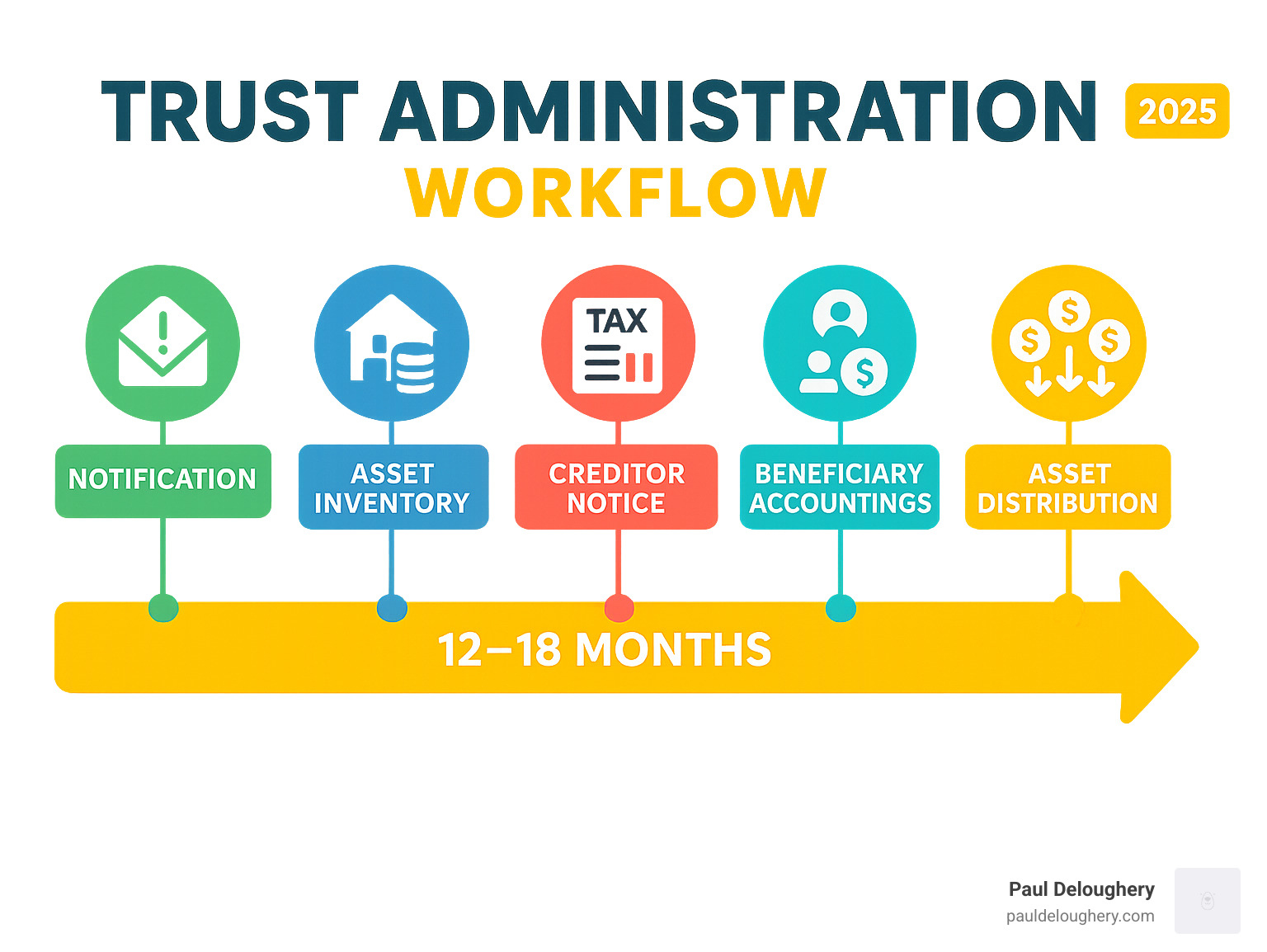
This involves managing assets, ensuring legal compliance, handling tax obligations, communicating with beneficiaries, settling debts, and maintaining meticulous records. The process typically takes 12-18 months, though complex trusts may require longer. Trustees have fiduciary duties to act in the best interests of beneficiaries, requiring loyalty, impartiality, and prudence in preserving trust assets.
While trust administration is often significantly less expensive than probate and offers greater privacy, it demands careful attention to detail. Mistakes can lead to personal liability for the trustee and destructive family disputes.
I’m Paul Deloughery, an estate planning attorney with 25 years of experience helping families in Arizona and Minnesota steer trust administration. I guide trustees through this complex process, protecting them from litigation and ensuring their loved ones receive their intended inheritance.
Understanding Trust Administration Fundamentals
The person who creates a trust—the trustor, grantor, or settlor—leaves precise instructions on how their assets should be managed and distributed. A trust is a legal entity that can own property, allowing assets to bypass the public and often lengthy probate process. The core purpose of trust administration is to ensure the grantor’s wishes are carried out exactly as intended by managing assets, maintaining legal and tax compliance, and keeping beneficiaries informed.
Key Players in Trust Administration
Every trust involves key roles:
- The trustee holds legal title to trust assets and is responsible for managing them for the beneficiaries. The grantor often serves as the initial trustee, naming a successor trustee (a family member, friend, or professional) to take over upon their death or incapacity.
- Trustees have fiduciary duties, a legal obligation to act with complete loyalty, prudence, and impartiality. They cannot favor one beneficiary, use trust assets for personal gain, or manage assets carelessly.
- The beneficiaries are the individuals or organizations who receive the trust’s benefits. They have the right to receive information, request accountings, and ensure the trustee is fulfilling their duties.
When Trust Administration Becomes Necessary
Trust administration begins when a triggering event occurs. Death is the most common trigger, causing a revocable trust to become irrevocable and activating the successor trustee’s duties. This starts the clock on important deadlines, like the statutory notice period for informing beneficiaries of their rights.
Incapacity can also trigger administration if the grantor becomes unable to manage their affairs, requiring the successor trustee to step in. Some trusts, known as irrevocable trusts, are created for tax or asset protection purposes and require administration as soon as they are funded.
After a death, there is a contest period where the trust’s validity can be challenged. Proper administration during this time is crucial to demonstrate adherence to the grantor’s wishes and defend against disputes. The distinction between revocable trusts (changeable during the grantor’s life) and irrevocable trusts (generally unchangeable) dictates the trustee’s flexibility and how the administration process unfolds.
The Complete Trust Administration Process Step-by-Step
Trust administration is a detailed process that typically takes 12-18 months, though complex situations can extend this timeline. Following these steps methodically is key to a successful outcome.

Initial Steps and Document Gathering
Once a trust becomes active, the successor trustee must act promptly.
- Meet with legal counsel: An experienced trust administration attorney is crucial for avoiding costly mistakes and navigating legal complexities.
- Obtain death certificates: You will need multiple certified copies (typically 10 or more) for financial institutions, insurance providers, and government agencies.
- Locate the trust document: This document, including all amendments, is the roadmap you are legally bound to follow.
- Identify all trust assets: Create a comprehensive inventory of bank accounts, investments, real estate, business interests, and personal property. Reviewing past tax returns can help uncover overlooked assets.
A common issue is “asset misalignment,” where assets were never properly titled in the trust’s name. In Arizona, we find this in up to 90% of trusts, potentially forcing an estate into the probate process the trust was designed to avoid.
Asset Management and Protection
As trustee, you are responsible for protecting and managing the trust’s assets.
- Asset marshaling: Gather all assets under the trust’s control, which may involve retitling accounts or property that the grantor overlooked.
- Secure physical property: Change locks on real estate, secure vehicles, and ensure properties are monitored to prevent vandalism or damage.
- Obtain professional appraisals: Appraisals determine the fair market value of significant assets as of the date of death, which is essential for tax purposes and ensuring fair distributions.
- Make prudent investment decisions: Trustees must follow the prudent investor rule, making sensible, diversified investments that align with the trust’s goals. Consulting a financial advisor is often wise.
Legal Compliance and Notifications
This phase is critical for avoiding liability.
- Notify beneficiaries: States have strict deadlines for notifying beneficiaries of the trust and their rights. In Arizona, A.R.S. Section 14-10813 of the Uniform Trust Code requires notice within 60 days of the trustor’s death.
- Address creditor claims: Follow the state-mandated process for notifying creditors and settling valid debts. For example, Delaware gives creditors eight months to file claims. Assets cannot be distributed until this period ends and debts are paid. (Arizona does not have a specific statute related to handling creditor claims related to trusts.)
- Handle court filings: While not always required, court involvement may be necessary to resolve disputes or interpret ambiguous trust terms.
- Maintain ongoing communication: Regular updates and annual accountings for beneficiaries build trust and prevent most disputes. Transparency demonstrates that you are fulfilling your duties responsibly.
Throughout this process, consulting with an estate planning attorney is essential to steer state-specific requirements and protect both the trustee and the beneficiaries.
Tax Obligations and Financial Responsibilities in Trust Administration
Managing tax and financial duties is one of the most critical aspects of trust administration. We recommend working with a CPA who specializes in this area.

Federal and State Tax Requirements
The trustee is responsible for filing all necessary tax returns. Key filings include:
- Final Personal Income Tax Return (Form 1040): Covers the trustor’s income up to their date of death.
- Fiduciary Income Tax Return (Form 1041): The trust’s own tax return for income generated by its assets. Trusts have compressed tax brackets, reaching the highest federal rate at just over $14,000 of income (in 2023), making tax planning crucial.
- Federal Estate Tax Return (Form 706): Required if the gross estate exceeds the federal exemption ($12.92 million per person in 2023). The deadline is nine months after death.
- State Estate or Inheritance Taxes: Some states impose their own taxes with different rules and exemptions.
The trust will need its own Employer Identification Number (EIN) from the IRS to open bank accounts and file returns. For married couples, the surviving spouse should consider the portability election, which allows them to use the deceased spouse’s unused federal estate tax exemption. This requires filing Form 706 even if no tax is due.
Debt Settlement and Expense Management
Before distributing assets to beneficiaries, the trustee must pay all legitimate debts and administrative expenses. This requires meticulous record-keeping.
- Creditor Claims: Notify potential creditors and validate all claims before payment.
- Funeral Expenses: These are typically a top priority and are paid from trust assets.
- Administrative Costs: These are necessary expenses paid from the trust. They include reasonable trustee fees (often around 1% of assets annually), legal fees for attorney guidance, accounting fees for tax preparation, appraisal fees for valuing assets, and costs for property maintenance and insurance.
The trustee must maintain detailed records of all income and expenses for both beneficiary transparency and IRS compliance.
Common Challenges and How to Avoid Costly Mistakes
Trust administration is not without pitfalls. Many people focus so on avoiding probate that they overlook the second and third-order consequences of their planning. Mistakes made in this process can unintentionally disinherit loved ones, especially in blended families, and create more conflict than the probate process they sought to avoid.

Preventing Fiduciary Liability
A trustee’s fiduciary duty is a heavy burden, and breaches can lead to personal liability. These problems are preventable:
- Avoid Self-Dealing: Never use trust assets for personal benefit or engage in transactions with a conflict of interest. This is a strict rule with severe penalties.
- Keep Meticulous Records: Document every transaction, communication, and decision. This paper trail is your best defense against future disputes.
- Be Transparent with Beneficiaries: Regular updates and detailed accountings are legal requirements that also preserve relationships. As research confirms, ensuring beneficiaries are being looked after requires consistent, clear communication.
- Seek Professional Guidance: When in doubt, consult attorneys, CPAs, or financial advisors. These professional fees are typically paid from trust assets and protect you from liability.
Resolving Beneficiary Disputes
Wealth transfer can amplify underlying family tensions. The key to prevention lies in planning and communication.
- Ensure Clear Grantor Intentions: A trust document that clearly explains the reasoning behind distributions makes it harder for beneficiaries to argue about fairness.
- Address Blended Family Complexities: Single “pot trusts” for all children can cause conflict over discretionary distributions. Consider separate trusts for different family branches or equalization provisions to ensure fairness over time. (I had a case decades ago involving two children. The one child was going to require intense therapy that would take up the entire amount in the trust. We needed to go to court to separate the “pot trust” into separate trusts so the other child would inherit something.)
- Hold Family Meetings: Discussing the estate plan during the grantor’s lifetime manages expectations and reduces resentment.
- Prepare Heirs for Wealth: Successful generational wealth transfer is about more than legal documents; it requires preparing people to receive wealth responsibly. Instilling family values, sharing history, and explaining the purpose behind the wealth creates a foundation for stewardship. This educational approach is as vital as the trust itself.
If disputes arise, mediation offers a cost-effective, less adversarial alternative to litigation that can preserve family relationships.
Professional Guidance and When to Seek Help
While some trustees attempt to manage the process alone, the complexities and potential liability of trust administration make professional guidance essential. Trying to “save money” by forgoing expert help often leads to costly mistakes that far exceed the fees for professional services.
Corporate trustees and trust companies offer specialized expertise in investment management, tax compliance, and legal requirements. Crucially, they provide neutrality. When family emotions are high, a professional trustee can make objective decisions based solely on the trust’s terms and the beneficiaries’ best interests.
Even if a family member serves as trustee, working with a team of professionals is wise. Attorney consultation ensures legal compliance, CPA services handle complex tax filings, and investment advisors help manage trust assets prudently.
Choosing Between Individual and Professional Trustees
Selecting a trustee is a critical decision in estate planning.
-
Individual Trustees: A family member or friend brings intimate knowledge of the family’s values. However, they often underestimate the time commitment and may lack the necessary expertise in law, finance, and taxes. Maintaining impartiality can be extremely difficult when navigating competing interests among relatives. (Also, non-professional trustees can be dishonest or careless. I’ve had plenty of situations where a family member stole or mismanaged trust assets of minor child beneficiaries. The children couldn’t protect themselves.)
-
Professional Trustees: Trust companies and fiduciary services bring expertise, systematic processes, and neutrality. While their fees (often 1-2% of assets annually) are higher, this cost can be minor compared to the potential losses from administrative errors or family litigation.
A hybrid approach is often effective. A co-trustee arrangement, pairing a family member with a professional, combines personal insight with expert objectivity. For trusts with significant assets, complex holdings, or a history of family conflict, a professional trustee is essential for preserving both wealth and harmony.
Frequently Asked Questions about Trust Administration
After 25 years in this field, I’ve found that certain questions arise repeatedly. Here are concise answers to the most common concerns.
What is the difference between a trustee and a trust administrator?
While the terms are often used interchangeably, they have distinct roles. The trustee is the legal decision-maker who holds title to the assets and is ultimately responsible for fulfilling the trust’s terms. They bear the full fiduciary duty. A trust administrator handles the day-to-day operational tasks—paperwork, communications, and coordinating with professionals—often working for the trustee. In family situations, one person may act as both, but in larger institutions, the roles are separate.
How long does the trust administration process typically take?
For a straightforward trust, the process usually takes 12 to 18 months. However, the timeline can be longer depending on several factors:
- Complex Assets: Selling real estate or valuing and transferring business interests can take significant time.
- Beneficiary Disputes: Disagreements among beneficiaries can bring the process to a halt and lead to lengthy delays.
- Statutory Waiting Periods: States impose mandatory waiting periods for creditor claims (e.g., eight months in Delaware) that cannot be shortened.
Even with these factors, trust administration is generally faster and more private than probate, which can often take 18 to 24 months.
What are the typical costs associated with trust administration?
Proper administration has costs, but it is generally less expensive than probate and far cheaper than correcting mistakes. All fees are paid from trust assets, not the trustee’s personal funds. Key expenses include:
- Trustee Fees: Trustees are entitled to reasonable compensation for their work and liability, typically 1% to 2% of trust assets annually. Family members may choose to waive this fee.
- Legal Fees: An experienced attorney is essential for guidance and liability protection. Hourly rates can range from $350 to $650.
- Accounting Fees: A CPA is needed to prepare fiduciary tax returns (Form 1041, Form 706), with fees often ranging from $500 to $2,000+ per year.
- Other Costs: These include appraisal fees for valuing assets, investment management fees, and property maintenance costs.
These costs are an investment in ensuring the trust is administered correctly, protecting the trustee, and preserving family harmony.
Conclusion
Trust administration is the critical final step in your estate plan, turning your intentions into a tangible legacy for your loved ones. The process is the bridge between your planning documents and their successful execution.
Even the best-drafted trust can fail without proper administration, leading to family conflict and diminished assets. Conversely, when a trust is administered with care and professional guidance, beneficiaries receive the full measure of the love and intention behind their inheritance.
For trustees, seeking help is a mark of wisdom. The complexities of law, tax, and family dynamics make professional guidance essential. The cost of expert advice is minimal compared to the consequences of mistakes.
Trust administration is about more than transferring assets; it’s about preserving family harmony and ensuring your legacy is a blessing. At Paul Deloughery, our approach goes beyond legal compliance to encompass the full spectrum of legacy preservation.
Through our estate planning services, we help families steer every aspect of wealth preservation. Whether you are creating a plan or serving as a trustee, our plan provides the framework to protect your family’s future and ensure your values endure across generations. Your legacy is too important to leave to chance.